
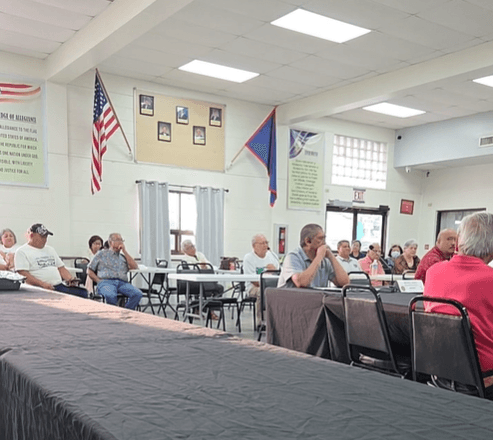
Residents of Tamuning, Tumon and Harmon shared mixed views during a public hearing on proposed changes to the spelling and pronunciation of Tamuning and Tumon, with some supporting the effort to restore CHamoru place names while others questioned whether the changes should be a priority.
Tamuning-Tumon-Harmon Mayor Louise Rivera said the hearing was held at the request of the Kumisión I Fino' CHamoru, which is seeking the support of the Tamuning-Tumon Municipality Planning Council in recommending that the Guam Legislature change the village names to Tamuneng and Tomhom.
The hearing gave residents an opportunity to provide input before the municipal planning council decides whether to support or oppose the recommendations.
Kumisión member Robert Underwood, who discussed the historical and cultural context behind the proposals, said the changes must be made through legislation because village names identify political jurisdictions.
“It can only be changed by law and there's a specific reason that that can only be changed by law, because that's a political jurisdiction. It has implications for taxes, it has implications for elections, it has implications for residency,” Underwood said.
Underwood said the Kumisión has worked through a similar process with several villages, including proposals to restore spellings such as Hågat for Agat, Talo'fo'fo, Inalåhan, Malesso and Humåtak.
He said some communities were more receptive than others, citing Santa Rita as an example of a village where a compromise was reached.
Underwood explained that Tamuning originally referred to Apotgan, an area settled by Carolinians. Tamuning is a Carolinian word meaning “arrival of the chief,” he said. Over time, the name came to refer to the broader area rather than just Apotgan.
The proposed change to Tamuneng recognizes the name's historical and generational use, Underwood said.
When asked why the village was not being renamed Apotgan, Underwood said that option had been discussed but would be difficult to advance. He said the Kumisión ultimately decided not to pursue it.
Underwood pointed to Santa Rita-Sumai as an example of compromise, explaining that Sumai is a traditional CHamoru place name that was incorporated into the village's name.
Several residents voiced support for the proposed changes, including John Leon Guerrero, who described the hearing as an opportunity for the community to participate in decisions about how places are named.
“I think this is a wonderful opportunity to make a decision and to take that finite time to decide ... it's an opportunity where we are allowed and being given a chance to contribute to how these names and how these places are named. Whereas in the past, that always didn't happen,” Leon Guerrero said.
He encouraged the municipal planning council to support the Kumisión's recommendations.
Maria Cristobal Hattori, a parent, also supported the changes, saying accurate spelling would help children and visitors learn to pronounce village names correctly.
“And if you them to say it right, you have to spell it right,” she said.
Hattori argued that spellings such as Sinajana, where the “J” is pronounced as an “H,” reflect Spanish colonial influence.
“So why don't we spell it properly? Spell it the way we say it so our kids can say it right, so our visitors can say it right. Malesso not Merizo, Humåtak not Umatac. I would like our island names to be spelled properly ... it's making it right,” she said.
Rivera said she supports preserving the CHamoru language but acknowledged that some residents have raised concerns about the proposed changes and other community priorities.
“The people have talked to us and a lot of our council members that have been doing their homework have been getting information back, about, 'what's that? Don't change it, you know let's take care of other things, fix the roads, take care of the stray dogs, fix the streetlights. All these different things that are coming back at us. And so, they're expecting that,” Rivera said.
Rivera said some residents may be more receptive to the name changes if other concerns are addressed. She said the feedback has made it difficult to determine how the municipal planning council should vote.
“I mean what is expected from our council? Because we're hearing what our people are saying and that's why it was very important for me to say that part of it, if you're a resident of Tamuning,” she said.
Rivera described the decision as difficult, emphasizing that questions about the proposed changes should not be interpreted as opposition to CHamoru culture or tradition.
“This one was a hard one and ... I don't want anyone to ever think that we are against our culture and our tradition with name change,” she said.
Underwood acknowledged residents' concerns but said the proposed spelling changes are relatively straightforward. He also said municipal planning council members have a responsibility to exercise their own judgment and knowledge rather than simply relay public comments.
Residents may submit additional testimony to the Tamuning mayor's office. The municipal planning council will then vote on whether to recommend the proposed changes or retain the current spellings.
The Guam Legislature would make the final decision on whether to enact the changes.