
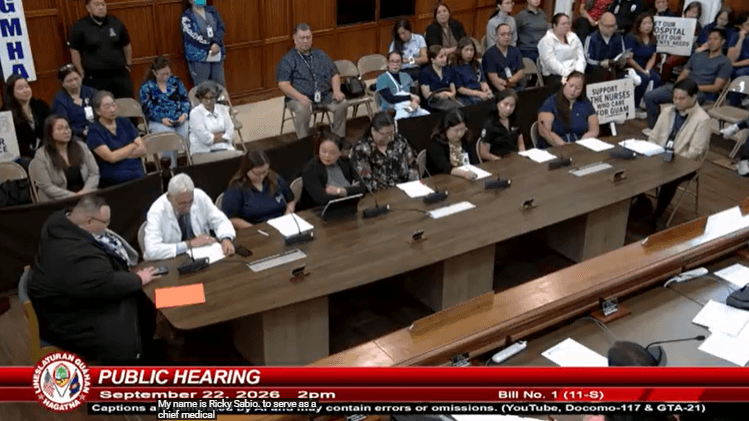
A statement from Adelup in response to Wednesday's public hearing on the use of additional Section 30 funds for the Guam Memorial Hospital Authority, stressed the urgency of replacing the hospital's electronic health record and revenue cycle systems.
The governor's office contends that "there is little time to waste," noting that GMHA's clinical and financial systems do not properly communicate with each other.
"Bill No. 1 addresses the systems used every day at Guam’s only public hospital. When someone arrives at GMH with a heart attack, stroke or sepsis, the treating physician needs to know what medications that patient takes, what allergies they have, what tests have shown and what treatment has already been provided. That information needs to be available when the decision is being made—not found later in another system or reconstructed during an outage," the governor's office said.
According to the governor's office, the availability of that information across systems is becoming increasingly difficult.
"CareVue is failing with increasing frequency, and during outages doctors and nurses return to handwritten orders, telephoned results and paper records. Manufacturer support for the servers running the hospital’s billing system ends in December, and components have already degraded or failed," the governor's office said.
The governor's office also stressed the urgency of replacing the revenue cycle systems, which experienced a system failure in 2023.
"GMH can only bill for care it can document. Under the current system, charges can go uncaptured, claims can be denied and bills can go out late. After a system failure in 2023, GMH’s claims fell so far behind that the hospital borrowed millions in Medicaid advances to meet payroll," the governor's office said.
The governor's office recognized that there are three other "important proposals" competing for additional Section 30 funds totaling nearly $20 million.
"Each is a legitimate need. Limited resources still require choices," the governor's office said.
The urgency comes as the current clinical agreement expires in April 2028 and GMHA estimates it will take 15 to 18 months to implement a replacement.
The governor's office said, "Every month of delay reduces the time available to procure, implement, test and transition to a replacement while the existing system remains available. If there is another funded solution that can replace these systems safely, affordably and on time, bring it forward. The Administration will consider it seriously. But there must be a solution.”
During the hearing, the Department of Corrections, which has 971 inmates, about 85% of whom have serious health or medical issues, strongly supported funding for GMHA.
DOC Maj. Antone Aguon provided the department's position on the bill. He said, "The department's ability to provide timely appropriate health care off of often demands depends on access to accurate up-to-date medical information from multiple providers and agencies.”
DOC described the current process as heavily dependent on manual records and communication between separate systems, which can create administrative burdens, delay access to critical medical information and complicate continuity of care for individuals in custody.
“Because medical information is not always readily accessible through a unified electronic platform, health care staff often rely on paper records, manual document requests, telephone calls, and information exchange between separate healthcare systems.”
Speaker Frank Blas Jr. later questioned GMHA officials about whether the roughly $16 million would be enough to purchase an EHR system.
"The reason why I'm asking is the total amount to be appropriates is over $19 million and if the $15 million is going to be woefully short, why didn't you just take the whole $19 million? ....This is nowhere near the amount necessary to make a purchase for EHR," Blas said.
Acting Associate Administrator of Operations Jesse Quenga said the hospital did not indicate a monetary figure when its interim Hospital Administrator and CEO, Dr. Joleen Aguon, reached out to the governor in a letter asking for assistance.
"How that amount arrived came from the governor's office and her policy team," Quenga said.
Aguon, who is in California as part of the Guam delegation meeting with federal partners, said she intends to raise the EHR funding concern, among other hospital needs, during the meeting.