
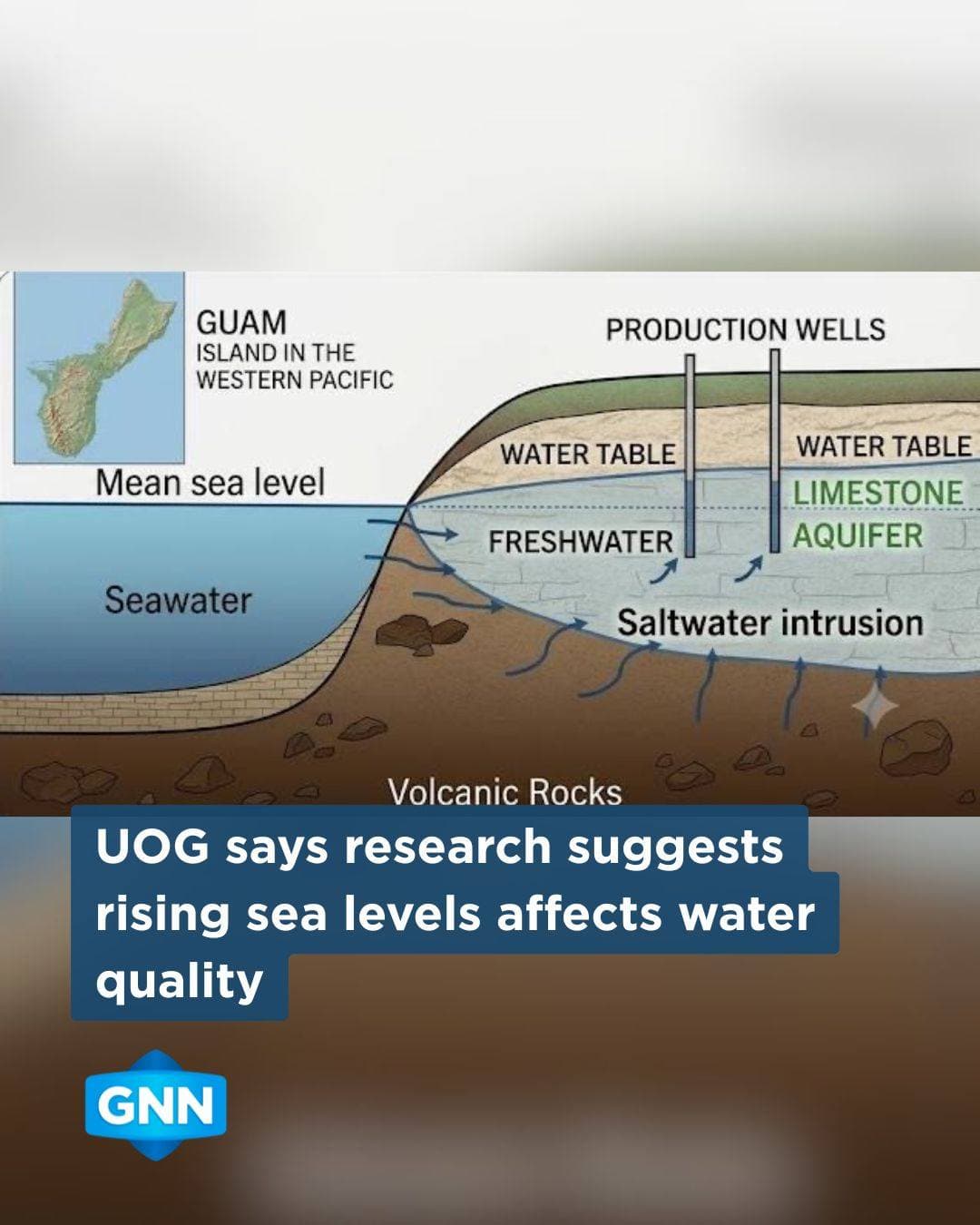
Rising sea levels may be impacting the quality of Guam's groundwater, according to a new study by University of Guam (UOG) researchers that used artificial intelligence (AI) to analyze more than 40 years of water quality data.
The study, published in the peer-reviewed journal Water, Air, and Soil Pollution, examined "long-term changes in chloride," which UOG explained is an indicator of saltwater intrusion in groundwater wells near Guam's coastline.
"The findings suggest that accelerating sea-level rise may be contributing to increased salt levels in some of the island's drinking-water wells," UOG said in a June 29 statement.
The study involved long-term groundwater monitoring data compiled by the Guam Waterworks Authority (GWA), with additional support provided by NASA's Established Program to Stimulate Competitive Research (EPSCoR) and the U.S. Geological Survey.
Barry Kim, UOG associate professor of water engineering at the Water and Environmental Research Institute of the Western Pacific (WERI), led the research along with Byoungyong Lee, associate professor of computer science, and other collaborators from partnering institutions.
The study suggested that as sea levels rise, saltwater is able to move farther inland, which increases chloride concentration.
UOG said this makes freshwater stored in underground aquifers "particularly vulnerable" to rising sea levels because almost all of Guam's drinking water sits above seawater in the underground aquifers.
UOG reported that past research conducted by WERI shows 70% of Guam's production wells have experienced increased chloride levels since the 1970s, some exceeding acceptable Safe Drinking Water Act levels.
"While scientists have long documented this trend, identifying its causes has been challenging because groundwater is influenced by many factors, including pumping rates, land development, drought, storms, and climate change," the UOG release said.
Analyzing more than 40 years of groundwater monitoring data from two GWA production wells in the Finegayan area, researchers used AI to examine how chloride levels changed over time and identified patterns that they said would have been difficult to detect with conventional methods.
The data was compared to groundwater records from before 1990 and after the early 1990s, when accelerated sea-level rise began in Guam, UOG said.
"The analysis found that one of the two wells, located closer to the coast, exhibited a noticeable shift in chloride patterns after 1993, suggesting that rising sea levels may be playing an increasingly important role in saltwater intrusion," UOG reported.
The goal was to better understand the factors contributing to increasing chloride levels in Guam's groundwater. Kim said, "AI allowed us to analyze long-term data in a new way and identify patterns that may not be apparent using conventional methods."
Other potential drivers of groundwater chloride concentrations, such as rainfall, were not "explicitly incorporated" into the study, and UOG acknowledged that more research is needed.
At the same time, UOG asserted that the findings provide "new evidence" linking climate-driven sea-level rise to changes in Guam's groundwater quality.
"The researchers say the results can help inform future water management decisions, including where new wells are developed and how existing wells are managed as climate conditions continue to change," UOG said.
UOG said the study also highlighted how "emerging technologies" can benefit environmental research.
The study states that integrating statistical data and machine learning methods with conventional methods provides "a more efficient and informed framework for addressing complex environmental problems."