
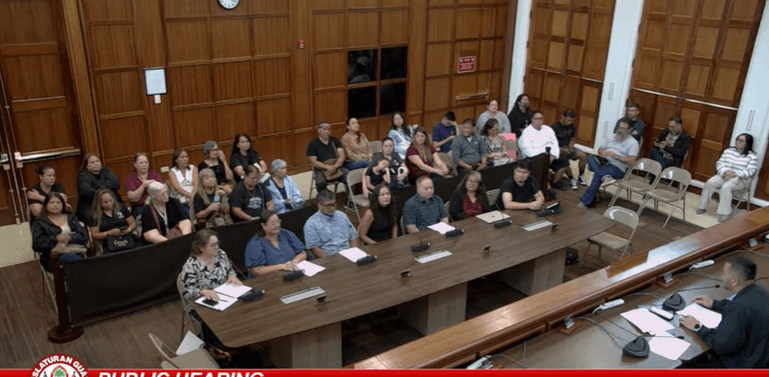
Testimony shared during Thursday's 4 p.m. public hearing on Bill 351-38, focused heavily on concerns that teacher pay is contributing to recruitment and retention challenges at the Guam Department of Education.
As introduced, Bill 351-38 would allow GDOE to manage its own position classification structures, pay grades and salary schedules, as well as step progressions, recruitment and retention incentives separate from the Department of Administration. It would also give GDOE control over compensation policies and employee benefits programs.
The first to testify was Kyle Adriano, a band teacher at F.B. Leon Guerrero Middle School who has dipped into his own pocket on several occasions to purchase classroom equipment despite earning what he described as a modest salary.
"I make $1,374.01 net biweekly. I pay for my car; I pay for my rent. I have currently purchased equipment, totaling worth $1,151.74. This is not the total that I have spent in my two years of teaching, nor is it the total from the beginning of this year. This is the amount that was purchased for this school year alone. School year 2627. This is $1,151.74. These purchases do not include instruments. I am unable to provide instruments for the students, and I already do have my students use some of my personal equipment. including a bass guitar, trombone, and keyboard. Just the trombone alone is worth a total of $1,200," Adriano said.
Adriano's testimony highlighted a recurring concern that has been recognized in past discussion on teacher compensation and classroom resources.
Andrea Santos, a ninth-year school counselor at FBLG Middle School echoed the Adriano's concern, describing the use of personal funds by teachers as a "sacrifice."
"They sacrifice their own money. Hours of their own time, doing things far outside the bounds of their job descriptions, because they are committed to their cause, and they are motivated by the sincere love for the people and the future of our island. Like so many of our schoolteachers, I am able to do this, to make these sacrifices, because we have second, and sometimes third jobs," Santos said.
Santos is also an adjunct professor at the University of Guam. She argued that the rate at which teachers are paid shows that teachers are "not valued."
She contended that low compensation coupled with higher and extraneous demands of teaching contribute to the decreased interest in the profession.
Santos cited a University of Guam student and workforce enrollment report that showed 320 students enrolled in education pathways in 2020.
"Only five years later, in the fall of 2025, the same report lists 164 students. Please hear this. There are half as many students committing themselves to education in just five years. This is a terrifying trend, but it makes sense," she said.
Marilyn Garcia Collins, an educator with 30 years of teaching experience in California and Guam, pointed to the disparity in pay between teachers in Guam and those in the continental United States. She is a multilingual math teacher at Agueda Johnston Middle School.
She supported Bill 351-38 stating it would raise teacher salaries to the 95-percentile of the national average teacher salary and allow the five-year period to get there.
"This would help us keep teachers we already have and perhaps attract our island people back into education as a career choice and even attract off-island teachers," Collins said.
Bill 351-38, introduced by Sen. Vincent Borja, chair of the legislative Committee on Education, Libraries and Public Broadcasting, recognizes that the national average public school teacher salary for the 2025-26 school year was $76,552 and that Guam ranks 53rd out of 54 states and territories in annual median wages across all occupations and last among education and library occupations.
The bill also acknowledged that teachers are leaving Guam as a result of rising costs of living and the reduced purchasing power of educator salaries.
"As a result, many educators are leaving Guam for higher-paying jurisdictions where compensation is more competitive and better aligned with living expenses. This outmigration contributes directly to teacher shortages, classroom instability, increased reliance on provisional or substitute educators, and diminished continuity of instruction.," Bill 351-38 states.
Mary Okada, former president of Guam Community College, testified as a private citizen. She said she supports the intent of Bill 351-38 but offered several recommendations and sought clarification on portions of the legislation.
"First, the bill states general cost-of-living increases, which is on page two. I am not aware of any mechanism that the government of Guam provides for cost-of-living increases, except for lump sum amounts provided to GovGuam retirees. Is this Legislature intending to provide a cost-of-living adjustment? And if so, how often?" she said.
Okada, who serves as the vice Chair of the Guam Education Board, also suggested that covered personnel listed be aligned with job titles that exist within GDOE as well as agreements between the Guam Federation of Teachers and Education Board.
"Although the collective bargaining agreements do not include administrators, I would recommend that any study of GDOE employees include all administrators, including the superintendent and the deputy superintendents," Okada said.
As introduced, the bill covers classroom teachers, preschool teachers, instructors, substitute teachers, counselors, school psychologists, school nurses, librarians and media specialists, curriculum coordinators, instructional consultants, school administrators, and program directors.
Okada also suggested that any study be conducted by a third-party consultant as opposed to the current bill language which identifies the GEB and a recognized representative.
"Third-party consultant should also handle the initial appeals for employee classification, pay grade, assignment and step-placement based on their methodology," Okada said.
Okada suggested that the timeline of the study should commence later than Jan. 1, 2027, which is the deadline set in the bill to create the compensation structure.
"Perhaps this should be the commencement of the study, primarily because a new Guam Education Board will be elected in the next couple of months. As of today, there will be only two members returning to the board. Dr. Ron McNinch and Mr. Carl Torres II. This will allow the incoming board to take ownership of this process," Okada said.
She recognized the bill may help recruitment and retention. In terms of recruitment, she questioned whether above-step recruitment has been considered.
"Can the Guam Education Board identify a recruitment bonus, similar to what other industries or entities use? What programs exist to train individuals for the workforce? How about teacher apprenticeships or boot camps? Have these been explored? While career fairs are often at certain times of the year, what prevents us from increasing these efforts? Perhaps we should consider a program such as Troops to Teachers or Teach for America. Or create the emergency certification for interested individuals," Okada said.
She argued that in terms of the bigger picture the concern is unfunded mandates.
"For the past several years the Guam Education Board has been focusing on the coming, on coming into compliance with a collective bargaining agreement, with the CBA, with the GFT. I can remember in time, a time in ... 2004, when the funding allocated to GDOE was only enough to cover salaries, benefits, and utilities. I urge you to consider the financial ramifications to the department," Okada said.