
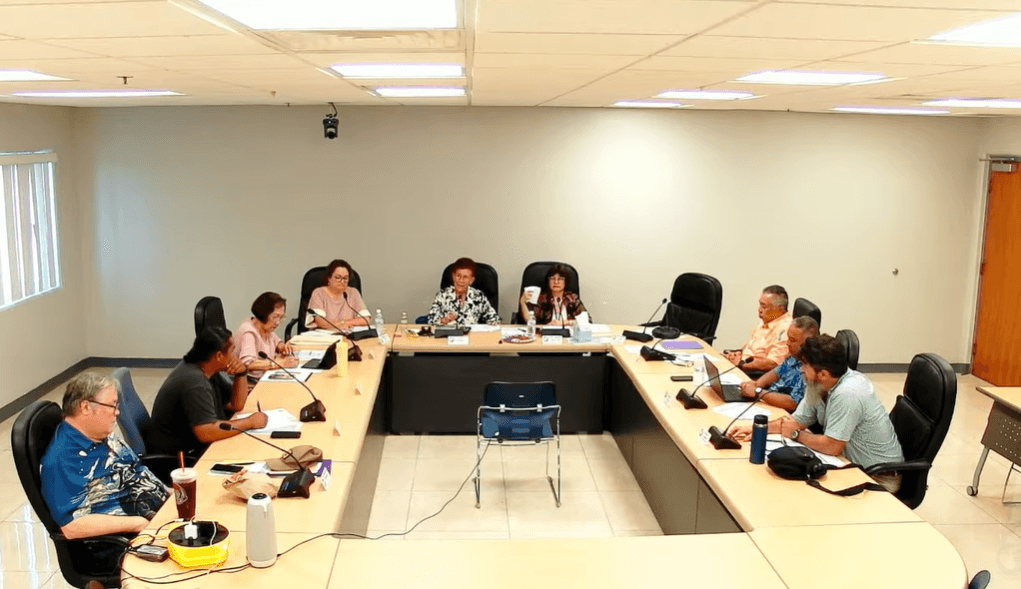
Heavy criticism of Guam Department of Education Superintendent Judith Won Pat's leadership dominated Monday's Guam Education Board meeting as students, parents and teachers from Simon Sanchez and Tiyan high schools demanded accountability for the displacement of both school communities.
Won Pat had difficulty trying to explain the events that led up to the two school populations being displaced three days into the new school year with the closure of the Tiyan campus for health and safety violations. Stakeholders visibly frustrated that redistricting was being considered, repeatedly interjected to express their disappointment.
"There's a lot of talk out there about who's responsible for who, who are we going to blame," Won Pat said before several attendees interjected, "You."
Won Pat emphasized repeatedly that the four options - asynchronous learning, double sessions, staggered schedules with some realignment of attendance areas and redistricting - were not her ideas.
With continued interjections Won Pat admonished attendees, "if you're educators, I'm sure you do not appreciate it if your students are going to be speaking out of turn like what you're doing right now. If you want me to give you the facts, I'm ready to do that. But please provide some courtesy."
While those in attendance stressed, they were "standing up" for the students. Won Pat defended her commitment to the department and its stakeholders stating all her children are products of the GDOE system, and her grandchildren are GDOE students.
Tiyan High was closed down after areas in use by Simon Sanchez were cited in the failed renewal sanitary inspection report issued for the entire facility.
She said she's put her neck on the line to remedy the violations cited in the Department of Public Health Sanitary Inspection report and get the campus reopened.
"As of last Friday, because I did not want to go beyond 10 days already as it is, I gave in and told the contractor proceed with the work and I'll get the billing later," Won Pat said.
However, she acknowledged that the problem with that is that it is like a blank check when GDOE is already strapped for cash.
"It's not the best decision to make because for all I know, they could charge me so much and we may not have the money for it. But I could not see our children, all of you out of school as it is already 10 days," Won Pat said.
She said, she will need to seek funding from the legislature to cover the costs.
The decision resulted in more than 100 Core Tech International workers showing up to Tiyan High School over the weekend.
"Again, I'm putting my neck on the line because I want them to finish it off this week and I want you to go back to your campus on Monday. But I can't do that unless I know that the construction company is going to assure us that they would complete the work and we'll pay for the work and open schools," Won Pat said.
Won Pat moved on to explain the challenges that management faced with the maintenance contract.
"We want to sit down with them, our attorneys ... and renegotiate this maintenance contract because current, we are at their mercy because they would charge us for labor. They'll charge us for labor, they'll charge us for materials, and they'll charge us 15% above that," Won Pat said.
GEB Chair Judith Guthertz contended they also learned something new about the contract related to the Leaseback agreement which allows GDOE to operate at the Tiyan facilities.
"We discovered something we never knew. The original contract between the government of Guam, and the company was amended ... in 2014. There were changes made to the original contract and the owner of the company, Mr. Ho (Eun) told us when we asked him about the repairs that Core Tech were responsible for, he said, 'we are not the owner any longer of the contract. The contract is owned by a nonprofit organization that simply contracts with Core Tech to handle the monthly caretaking of the Tiyan property,'" Guthertz said.
She also emphasized that GDOE is just the beneficiary of the original lease.
"In the last iteration of the agreement it says that DOE if it has to make improvements or repairs that it is responsible for at the school must use Core Tech to make the repairs and pay Core Tech for their services plus a 15% rate for overhead costs," Guthertz said.
She contended that the contract removes GDOE's ability to go out to bid for the work at Tiyan High.
"Like Won Pat says her hands are tied in terms of making improvements. She can only use Core Tech to do repairs that GDOE has to pay for even though DOE might want to go out to bid which is the current procurement law of the government of Guam," Guthertz said suggesting the contract may supersede the procurement law.
Later in the meeting, Jonathan Flis, a junior at Tiyan High School challenged those assertions.
He criticized the department for how the situation has been approached.
"Why are you having our principals solve the problems you are responsible for? Are you trying to have someone to blame in case something goes wrong? It seems like it's always somebody else, making the decisions instead of the one most responsible," Flis said.
He urged GDOE to practice what they preach.
"We are taught to have evidence to back up our decisions. We are taught to come to educated guesses. We are taught to think before we speak. So, tell me why the board of education cannot go through the same processes schools have taught us for years," Flis said.
Simon Sanchez Teacher and Guam Federation of Teacher GDOE Union Chair, Audrey Cruz echoed his concern, she said the "amount of finger pointing is frustrating" and called for stakeholder input to be considered.
"We need open communication, transparency and genuine consideration of stakeholder input. These should not be optional. They should be fundamental principles when making decisions that affect thousands of students, families, educators and entire school communities," Cruz said.
Earlier in the meeting education board members also contended there was a lack of stakeholder input at the levels seen during Superintendent Jon Fernandez leadership, which included multiple community engagement sessions and the development of the five-year strategic plan which identified collaborative leadership as its top strategic goal and calls for stakeholder engagement to support student success.
The board assured the community that no decisions regarding the options presented have been made and any redistricting or decommissioning of schools would require Board approval, which several members openly opposed.