
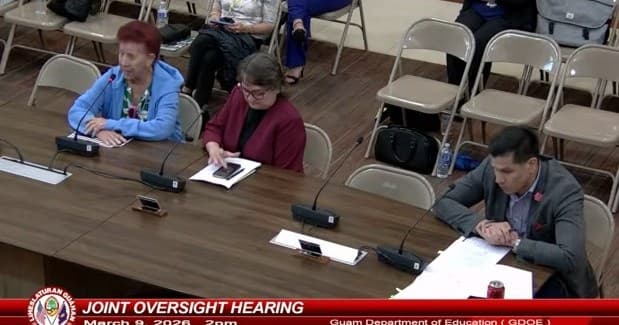
Senators pressed leaders of the Guam Department of Education (GDOE) and members of the Guam Education Board (GEB) during an oversight hearing that examined procurement issues, federal funding deadlines, a controversial management audit and the department’s long-term plan to eliminate double sessions in Guam’s public schools.
Focus on Pacific Policy Research Center Audit
A major discussion in the hearing centered on a management and curriculum audit commissioned by education officials. Lawmakers questioned board leaders about the report’s status after concerns were raised about errors and the process used to review it.
Board officials told senators the audit is currently under review after members identified several factual inaccuracies and requested revisions from the auditing firm.
According to board leadership, the report should have initially been routed through GDOE’s Internal Audit Office. Instead, the board asked the internal audit team to compile corrections and submit them to the firm.
Board Vice Chair Mary Okada told lawmakers that board members flagged several issues in the document, including misidentified individuals and incorrect titles.
“We provided input to the Internal Audit Office. They contacted the firm and submitted our requests for consideration,” Okada said during the hearing.
Officials said they expect to receive a revised version of the audit soon. Despite the concerns, board members noted that the report still includes recommendations that could help improve operations within Guam’s public school system.
Once the updated draft is returned, the board intends to review the recommendations and determine which reforms could be implemented.
Procurement Problems and Federal Funding Deadlines
The audit discussion took place alongside broader questions from lawmakers about GDOE’s administrative and financial management.
Department officials acknowledged ongoing problems involving expired contracts, delayed invoices and procurement delays tied to federal grant spending.
Some of those issues could affect the department’s ability to fully utilize remaining American Rescue Plan (ARP) funds tied to school refurbishment projects. Roughly $30 million remains connected to those projects.
Department leaders said they remain cautiously optimistic the funds can still be obligated before federal deadlines, but delays could force the government to find alternative funding.
“If we don’t get the invoice in time… then we look for local money, because there’s no other source,” GDOE Deputy of Finance and Administration Franklin Leon Guerrero told lawmakers while discussing the financial risks tied to missed deadlines.
To prevent similar problems in the future, GDOE leaders said the department is implementing new internal controls, including a centralized system that tracks contracts, purchase orders and procurement timelines.
Plan to End Double Sessions
Another topic raised during the hearing was the department’s long-term effort to eliminate double sessions in Guam’s schools.
Double sessions impact FB Leon Guerrero Middle School (FBLG) hosted by Okkodu High School, and Simon Sanchez High School (SSHS) hosted by John F. Kennedy High School.
Education officials told lawmakers the department’s facilities improvement strategy is designed in part to address this issue by integrating SSHS into Tiyan High School. At FBLG, students plans are to host at Astumbo Middle Schools and for some incoming 6th graders to remain at their current elementary schools.
The plan is temporary until students can return to their home schools following renovations at FBLG and the construction of 20 temporary classrooms for SSHS.
Officials said eliminating double sessions is a priority because it affects instructional time, extracurricular participation and overall student learning conditions.
Lawmakers said they want continued updates on the timeline for ending double sessions, particularly as federal funding tied to facility upgrades is nearing expiration.
Continued Oversight Expected
The hearing underscored ongoing legislative concerns about both the management of Guam’s public education system and the use of federal recovery funds.
Senators said they expect additional updates from GDOE and the Guam Education Board on the revised audit report, procurement reforms and the progress of facility upgrades aimed at ending double sessions.
Further discussions are expected as the Legislature prepares for upcoming budget deliberations and continues oversight of the island’s public education system.
