
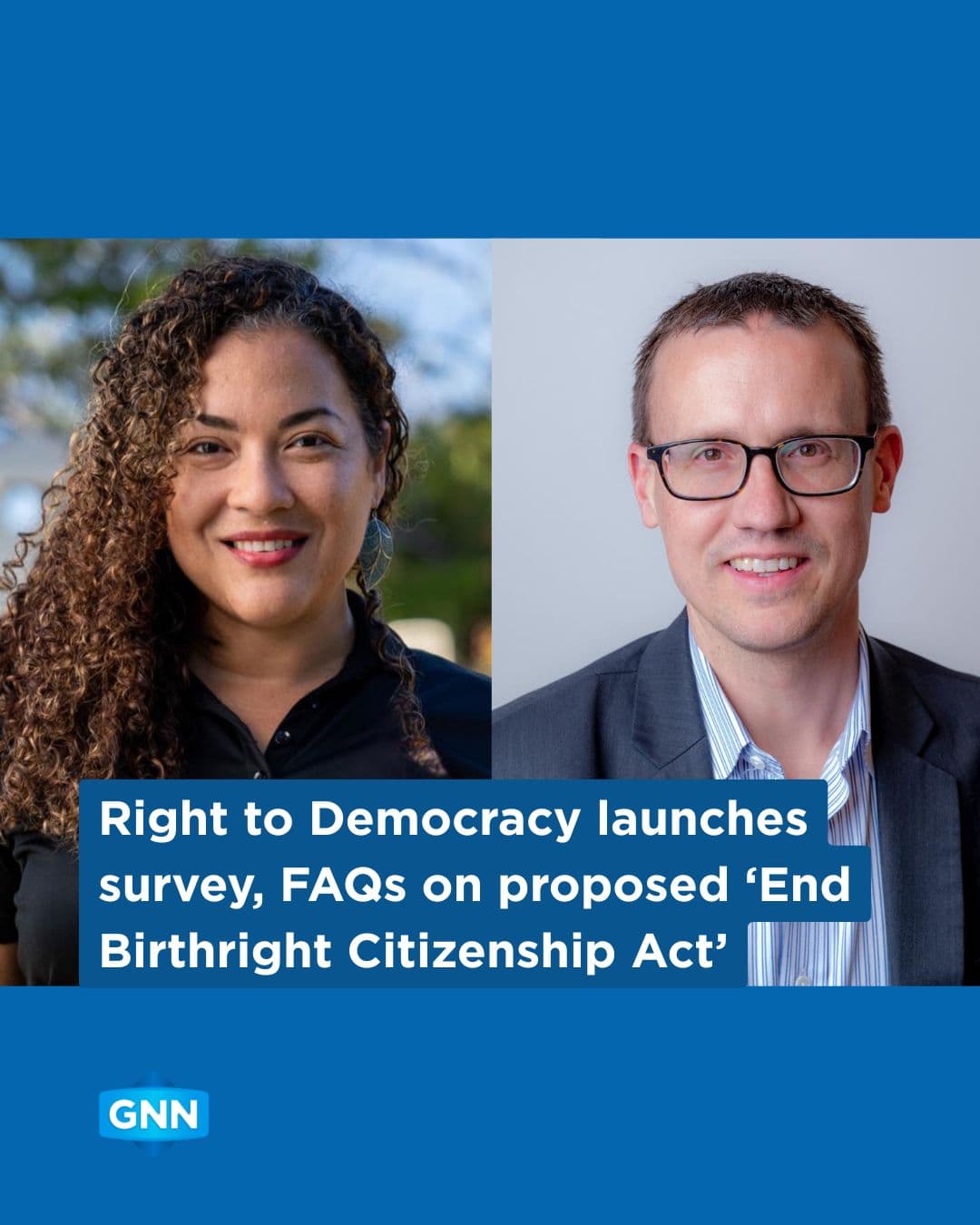
Right to Democracy has launched a new survey and FAQs regarding the proposed federal measure H.R. 9724, the End Birthright Citizenship Act, which has raised a lot of questions and misconceptions within the community.
The FAQs examine what the new legislation could mean for people born in U.S. territories and the historical and constitutional foundations of birthright citizenship.
“This bill has caused much concern and confusion, as it is even written in a sloppy way,” Adi Martínez-Román, Co-Director of Right to Democracy said.
She recognized that birthright citizenship is a "complex and sensitive topic," noting that Right to Democracy wants to help "clarify the legal and historical context."
One question Right to Democracy answers in the FAQs deal directly with what H.R. 9724 is noting it challenges birthright citizenship in U.S. territories.
"Relying on the Insular Cases and Territory Clause, the proposed legislation explains “Congress has the power to legislate with respect to the United States territories, including citizenship status,” emphasizing that “Congress has the inherent authority to change statutes relating to citizenship of persons born in the territories," the FAQs state.
The proposed measure, introduced by Rep. Morgan Griffith (R-VA-9), would amend the federal statutes that automatically recognize people born in U.S. territories — including Guam and the Commonwealth of the Northern Mariana Islands — as U.S. citizens, ending that recognition for anyone born on or after Jan. 1, 2027.
Griffith argues that the recent decision in Trump vs. Barbara "leaves the door open for Congressional action on citizenship in the American territories.”
“Just like Congress possesses the power to grant the territories Constitutional rights in statute, we have the power to take them away in statute," he added.
Griffith said the goal is to stop the so-called 'birth tourism' that is taking place in the American territories" — an occurrence he characterized as "abuse of birthright citizenship."
Right to Democracy said birth right citizenship also known as jus soli or right of soil was adopted by the United States, establishing that all people born on U.S. soil and subject to U.S. law are U.S. citizens regardless of who their parents might be.
It's part of the Citizenship Clause of the Fourteenth amendment which guarantees a constitutional right to citizenship based on birth on U.S. soil and right to citizenship to children of U.S. citizens born outside of the United States.
Because the bill is "poorly drafted," Right to Democracy is not "entirely clear" on the impact of H.R. 9724 on U.S. territories if passed.
"But if it were to pass, it could put at risk the citizenship status for anyone born in Puerto Rico, Guam, the U.S. Virgin Islands, or the Northern Mariana Islands as U.S. citizens on or after “January 1, 2027,” the organization said.
Right to Democracy's FAQs state that the bill creates a "limitation on citizenship." For Guam, this means "persons born in the island of Guam on or after April 11 1989, whether before or after August 1, 1950 and before January 1, 2027, subject to the jurisdiction of the United States are declared to be citizens of the United States."
Though the bill includes an "applicability" section, that the bill does not impact children born to U.S. citizens, the organization also says the "poorly" drafted bill leaves questions on the impact.
"Because these limitations are not included in the actual statutory amendments, that language would not appear in the statutes themselves, and thus not be binding on the courts," Right to Democracy states.
"Ultimately, the sweeping language included in the bill would put at risk the citizenship of anyone born in the covered territories on or after January 1, 2027, including children whose parents are U.S. citizens or lawful permanent residents," the organization added.
The full FAQ is available at https://www.righttodemocracy.us/birthright_citizenship_faq.
With the proposed legislation introduced, Right to Democracy has launched a survey seeking input from the communities that would be impacted.
"We want to hear directly from the people most affected by this proposal,” Neil Weare, Co-Director of Right to Democracy said. “This is not an abstract legal debate. It is about whether Congress or the President have to power to unilaterally decide that children born under U.S. sovereignty will no longer be citizens.”
The survey takes roughly 3 to 5 minutes to complete and can be found at
https://www.righttodemocracy.us/citizenship_survey.