
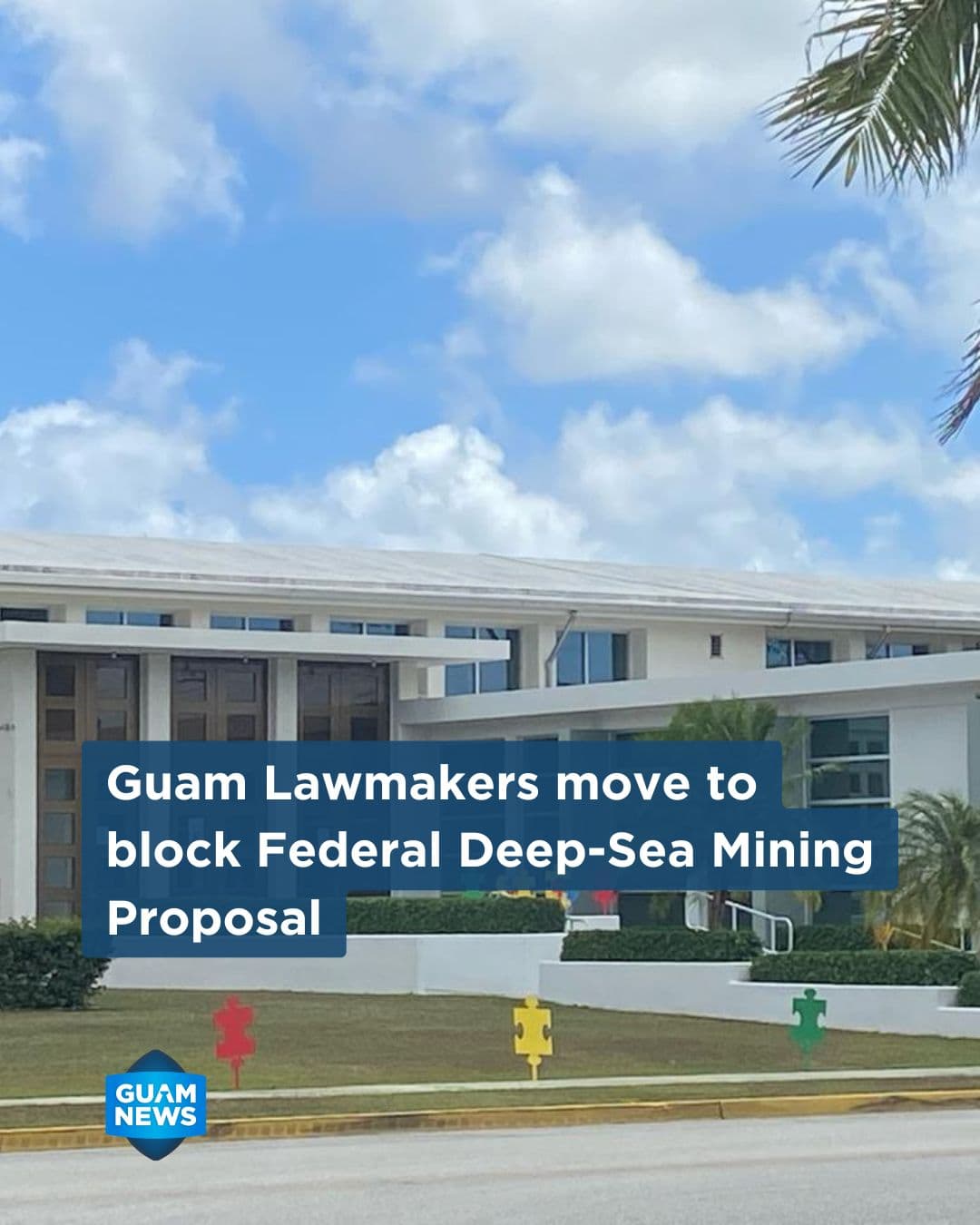
The Guam Legislature moved with urgency and unity Friday, convening an emergency session to advance a resolution opposing federal efforts to explore commercial deep-sea mining in waters near the Marianas, warning that the proposal threatens the island’s environment, economy, culture and future.
Resolution 132-38 was introduced after the U.S. Department of the Interior’s Bureau of Ocean Energy Management, or BOEM, issued a request for information seeking industry input on potential mineral leasing in the region. With the public comment deadline set for Jan. 12, lawmakers said immediate action was necessary.
“This is not a policy dispute. This is a test,” one senator told colleagues. “We do not consent to the destruction of our waters.”
The measure reaffirms Guam’s earlier call for a moratorium on seabed mining and formally objects to BOEM’s proposal. Lawmakers voted to move the resolution quickly through the legislative process, citing overwhelming public opposition.
During testimony and debate, senators described catastrophic risks associated with deep-sea mining, including irreversible damage to fragile habitats, permanent biodiversity loss, massive sediment plumes, disruption of fisheries and threats to undersea fiber-optic cables that support Guam’s economy and global communications.
Environmental experts told lawmakers the deep ocean remains among the least studied ecosystems on Earth, warning that damage could occur long before scientists fully understand the consequences.
Economic concerns were also raised. Government officials testified that roughly 60% of Guam’s gross domestic product is tied to marine-related tourism and recreation. Senators warned that seabed mining could undermine fishing, tourism and long-term sustainability for minimal or uncertain financial benefit.
Cultural leaders and residents described the ocean as inseparable from Chamorro identity, spirituality and survival. Several lawmakers said the proposal would inflict harm not only on ecosystems but on the people themselves.
“The ocean is not just a resource,” Terlaje said. “It is who we are.”
Legal experts testified that BOEM’s approach is inconsistent with international law recognizing the rights of non-self-governing territories to control their natural resources. Senators warned that federal agencies were advancing extractive projects without Guam’s free, prior and informed consent.
The resolution will be transmitted to the president, Congress, the Department of the Interior and BOEM. Lawmakers also urged residents to submit public comments before the Jan. 12 deadline, vowing continued resistance.
“We will not go down without a fight,” Terlaje said.