
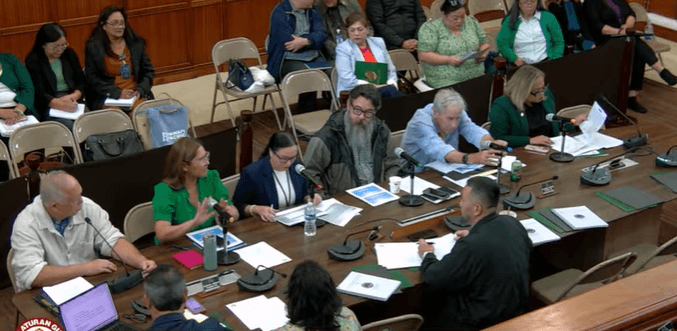
The Guam Department of Education (GDOE) acknowledged chronic staffing shortages within the department's Special Education Division, along with the reassignment of one-to-one aides as concerns were raised over whether students are receiving services mandates under each child's Individualized Education Plan or IEP.
On Wednesday, representatives from the GDOE, University of Guam, Guam Community College, charter schools, the Department of Integrated Services for Individuals with Disabilities participated in the legislative Committee on Education, Libraries and Public Broadcasting roundtable discussion focused on Special Education and disability services on Guam and how to move past the challenges with solutions.
GDOE Acting Assistant Superintendent of Special Education Asherdee Rosette explained that there is a total of 2,282 children with special needs serviced by the division this includes early intervention, preschool, elementary, middle and high school students. She said the majority are school-aged children.
"Almost two-thirds of that makeup ... is students with autism which has become the second largest disability category for the students that we serve through the Department of Education," Rosette said.
Rosette confirmed that the SPEd division provides speech and language therapy, occupational therapy, physical therapy, leisure and behavioral and autism education supports and transition services to students based on their IEP.
However, the division does not have the staff needed to provide the adult support aides or therapists to students with special needs.
Rosette said there are 220 adult support aide positions currently funded, but there are also an additional 165 requested positions by school principals that remained vacant as of Sept. 9.
GDOE's SPEd budget is roughly $18 million with 40% of the funding directed toward adult support aides, the 165 requested positions add to that cost.
"The conversation about the adult support is something we have been monitoring. I was just notified that we did put out an RFP (Request for Proposals) for an audit with regard to the adult support and that has been awarded. The notification went out and we're just waiting to finalize," Rosette said.
The RFP is intended to identify how GDOE SPEd can maximize supports and resources to address the additional 165 adult support aide positions requested by schools.
"What that means when we're looking at the adult support per capita of the outlying areas and that is those outlying areas are identified by OEP to include Guam, CNMI, the Virgin Islands Puerto Rico, the Federal States of Micronesia, American Samoa. Guam has the highest ratio of every six students with a disability, we have one aide that's assigned," she said.
Rosette explained that overall supervision of adult support is under the purview of school principals. She said when adult support assignments were reassessed for equity, the division looked at total support.
"We looked at all those numbers, for example is a school had eight adult support aides and they had an additional eight teacher assistants, we looked at reallocating the resource of the one-to-one aides who were federal funded for the specific reason of adult support and reassigning them to other schools," Rosette said.
Daniel Somerfleck emphasized that Guam is legally obligated under federal law to provide services despite funding limitations.
"You signed on the dotted line and took the money," he said. "As soon as you took the federal dollars, you were obligated to provide the services."
Sen. Chris Barnett echoed the concern, he said, "I'm hearing multiple parents is that even though their IEP mandates the adult support ... there are instances where ... the aides have been taken away."
He said in some instances adult support is on a case-by-case basis.
In addition to that various positions for academic evaluators, program coordinators and specialists remain vacant due to lack of applicants according to Rosette.
She said retaining staff and contracting services are the department's main challenges.
"We have limited personnel especially in the fields of occupational therapy, physical therapy, but we have done some partnership and outreach with the University of Guam CEDDERS," Rosette said.
The staffing shortage has resulted in autism-related supports not being available to all students.
Recruiting and retaining special education teachers is also a challenge. Though the Dr. Yamashita Teacher Corps remains an active scholarship program with $125,000 in funding for aspiring educators, University of Guam Senior Vice President and Provost Sharlene Santos Bamba said interest has declined.
"There is a decline in major declarations or those who want to enter the teaching profession. That is a national trend, and we saw this steep decline during COVID-19 pandemic," Bamba said.
Following the roundtable discussion Borja the committee on Education chair acknowledged the shortfalls but said the conversation must now remain focused on solutions and action.
“We already know where we are falling short,” Borja said. “Now we need to figure out what we can fix now, what our agencies can do differently, where we need to invest our resources, and what we need to work toward for the long term.”
The education committee said it would continue working with stakeholders and agencies to bring concrete administrative, policy and legislative solutions.