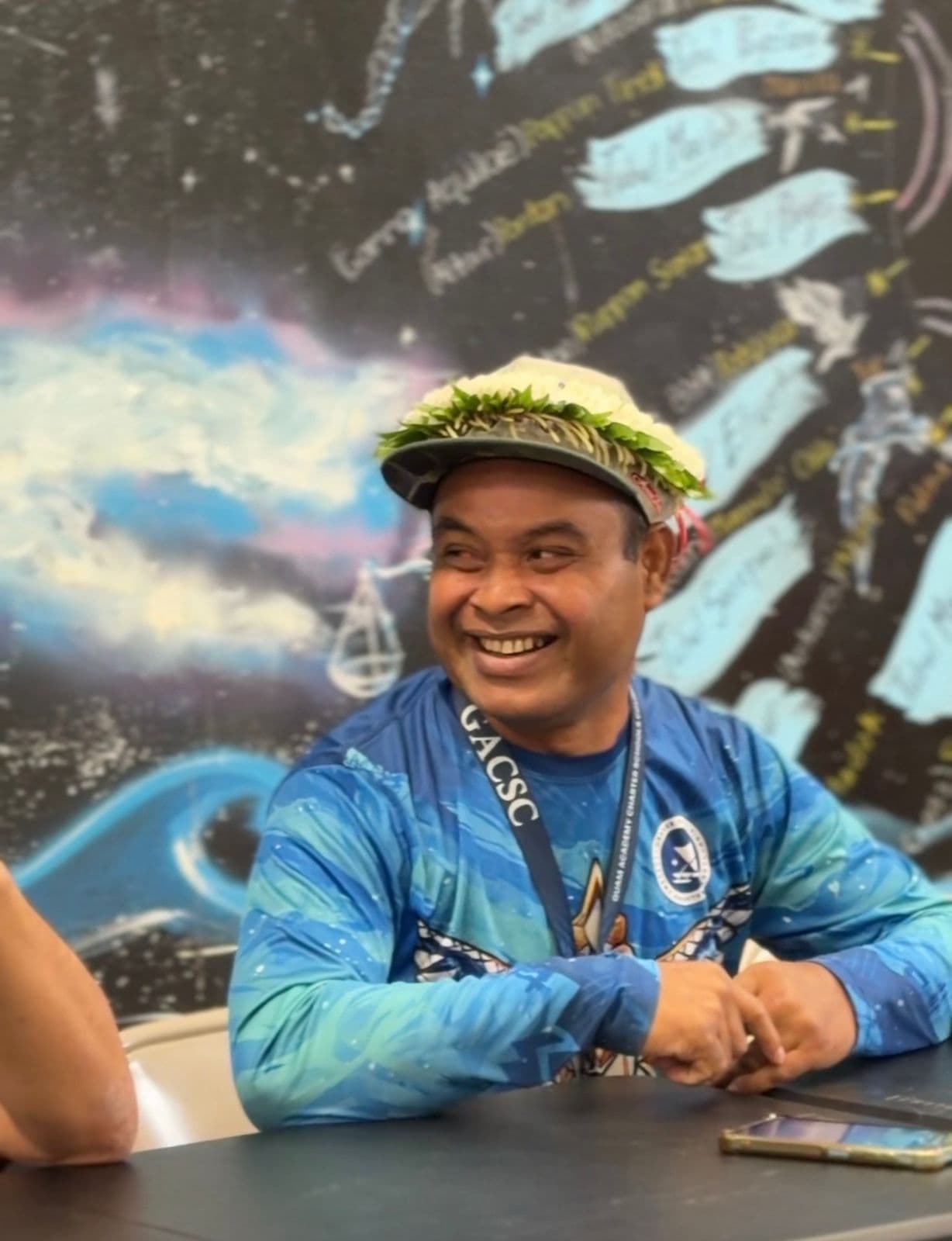
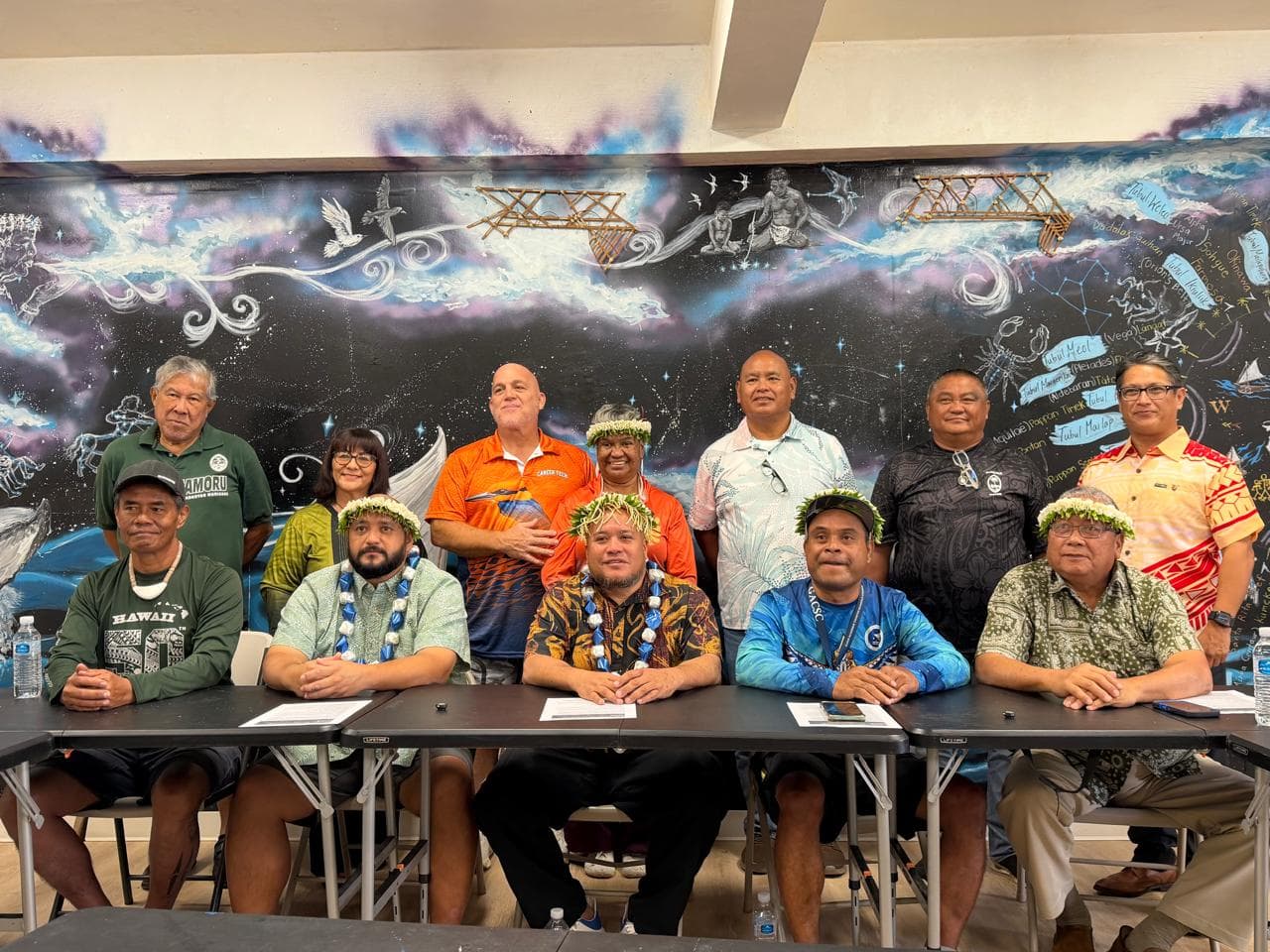
For education leaders at Career Tech Academy Charter School, Friday's gathering demonstrated the value of passing down knowledge from the region's manåmko, or elders, as students eagerly learned about traditional Pacific seafaring.
The students will be among the first to benefit from a covenant signed between the school and 500 Sails, a maritime cultural preservation nonprofit based in the Commonwealth of the Northern Mariana Islands.
500 Sails seafarer David Cabrera and Executive Director Master Navigator Jun Coleman along with Career Tech's Pwo Master Navigator Jerry Joseph used stories about their personal experiences voyaging across the Pacific region to spark the high school students' curiosity.
The students who attended the meet-and-greet with the cultural seafarers were selected by their teachers to participate in the event.
One student asked how they deal with seasickness explaining that when she first started paddling, she would get seasick frequently but now is "cherry."
"If you keep going through it you learn how to spot it early. For me, I just look at the horizon, I don't look at the water," Cabrera said.
Coleman shared that one of 500 Sails' youngest sailors just completed a voyage from Okinawa to Palau, despite becoming seasick along the way.
"She got seasick for like three days and everyone took care of her, made sure she's okay. Stay hydrated and it went away and then she was good," Coleman said.
He said the girl began interning with 500 sails while in high school and is now 21 working towards her Captain's license.
Joseph, a Satawal native a different approach to overcoming seasickness.
"Just throw them in the water, that's what we did. The small kids that usually sailed with us, once we know that they are really sick, we don't give them chance even though they are sleeping. While sailing, we say get ready we're going to throw them in the water. Just grab them and chuck them and they jump up ... and swim back to the canoe. But we're waiting, once they're on, no more seasickness, it's gone," Joseph said prompting laughter from the students.
Coleman shared that's how Grand Master Mau Piailug also got over seasickness as a young boy.
"Seasick, the grandfather threw him in the water. That will get you used to being on the canoe. You'd rather be on the canoe," Coleman said.
Students also questioned whether the seafarers had ever been on a voyage on a motorized boat with auto pilot.
"I used to captain a 50-foot canoe that had an engine and ... autopilot. That was a luxury because the engine is off, press it and it will hold your course," Coleman said. "Before back in the day, the traditional sailing they had nothing ... all we have is the ... conge shell."
He explained that on a traditional canoe everyone is on "watch."
"It's like a watch system, so, if you work for six hours then you get six hours off and the other group or crew will be working while you're sleeping, just so you don't burn out. On the traditional canoe, everyone is on watch," Coleman said.
The students also questioned how they find their way across miles of ocean.
"Back home the outer islands of Yap, we still don't have GPS, ... VHF radio," Joseph said.
"For me, it's kind of easier at night to stay on course, because during the day once the sun comes up, we have to rely on the ocean waves and sometimes if you're not paying attention or use to it, that's the hard part for me steering by swells in the middle of the day," Coleman said. "Nighttime the stars ... you use the stars to keep you on course. Maybe you're sailing with one star you don't just say 'okay that's the star, all we need. You have to look all over at all the other stars because if that one gets blocked by a cloud, you can use other back up stars."
Following the discussion with students' education and elected officials reflected on what they had witnessed. Career Tech Co-founder Andresina McManus shared that the idea behind the charter school is immersion.
"This whole idea of bringing tradition for our kids, it's not just a YouTube video and we're going to watch you just pass that history class. It was to come and be immersed in it and realize who you are. You're not from Compton, you come from ancestors that were here, thriving the stars and the seas, who knew their waters. And we are moving into a world where they need to develop sustainability with their own resources," McManus said.
She said hearing the students' engagement was validation of Western and cultural learning passed through oral storytelling coming together.
"I thought just the gaps that we had growing up that this was an opportunity for us to do a renaissance with our children, and our students to raise up a stronger generation of island children who know their language and celebrated their different languages, ... it's just a sense of I'm an islander first, before anything else," McManus said.
Career Tech formalized the partnership with 500 Sails, a maritime cultural preservation nonprofit from the Commonwealth of the Northern Mariana Islands on Friday with a shared goal to strengthen the Traditional Seafaring and Navigation Program, the cultural pillar of the school's Maritime Academy.
Career Tech said that the covenant is a binding promise between the two island communities to protect, teach, and pass forward the art of traditional Pacific wayfinding.
As part of the agreement the Career Tech campus will house and steward "the Boat Doctor," a canoe built on Guam by CHamoru craftsman Keith Quintanilla. The Boat Doctor is inspired by the 500 Sails mold.
Hosting the canoe will provide the students with "hands-on stewardship of a traditional built canoe as they train under the program's navigators, seafarers and watermen.