
Visitors to Vote Smart Guam, a nonpartisan voter guide for Guam’s 2026 election, cast 6,018 votes across 17 online straw polls between Aug. 9 and Sept. 30, according to final results published by the organization on Oct. 1.
The three candidate polls drew the most participation, with 2,093 votes in the gubernatorial race, 1,295 in the race for Guam’s delegate to the U.S. House of Representatives and 823 in the attorney general race. The other 14 polls, which covered voting and issues, received between 108 and 157 votes each.
Vote Smart Guam emphasized that the results are unscientific and should not be interpreted as an election forecast.
Anyone visiting the website could participate, and voters were not selected through a scientific sampling process. The results were not weighted to reflect Guam’s electorate.
Candidate poll results
In the gubernatorial straw poll, the Tony Ada/Edward Calvo ticket received 1,290 votes, or 62%, while the Therese Terlaje/Sabina Perez ticket received 609 votes, or 29%. Another 194 participants, or 9%, selected “Still deciding.”
In the delegate poll, James Moylan received 717 votes, or 55%, while Alicia Limtiaco received 546 votes, or 42%. Thirty-two participants, or 2%, remained undecided, according to the report.
The five-candidate attorney general poll recorded 823 votes. Phillip Tydingco received 487 votes, or 59%, followed by Douglas Moylan with 101 votes, or 12%; Peter Santos with 76 votes, or 9%; Thomas Fisher with 52 votes, or 6%; and Jordan Pauluhn with 38 votes, or 5%. Another 69 participants, or 8%, selected “Still deciding.”
Vote Smart Guam’s report lists candidates alphabetically rather than by standing.
The candidate figures reflect only participation in the online straw polls and do not establish how Guam voters as a whole intend to vote.
Cost of living tops issue poll
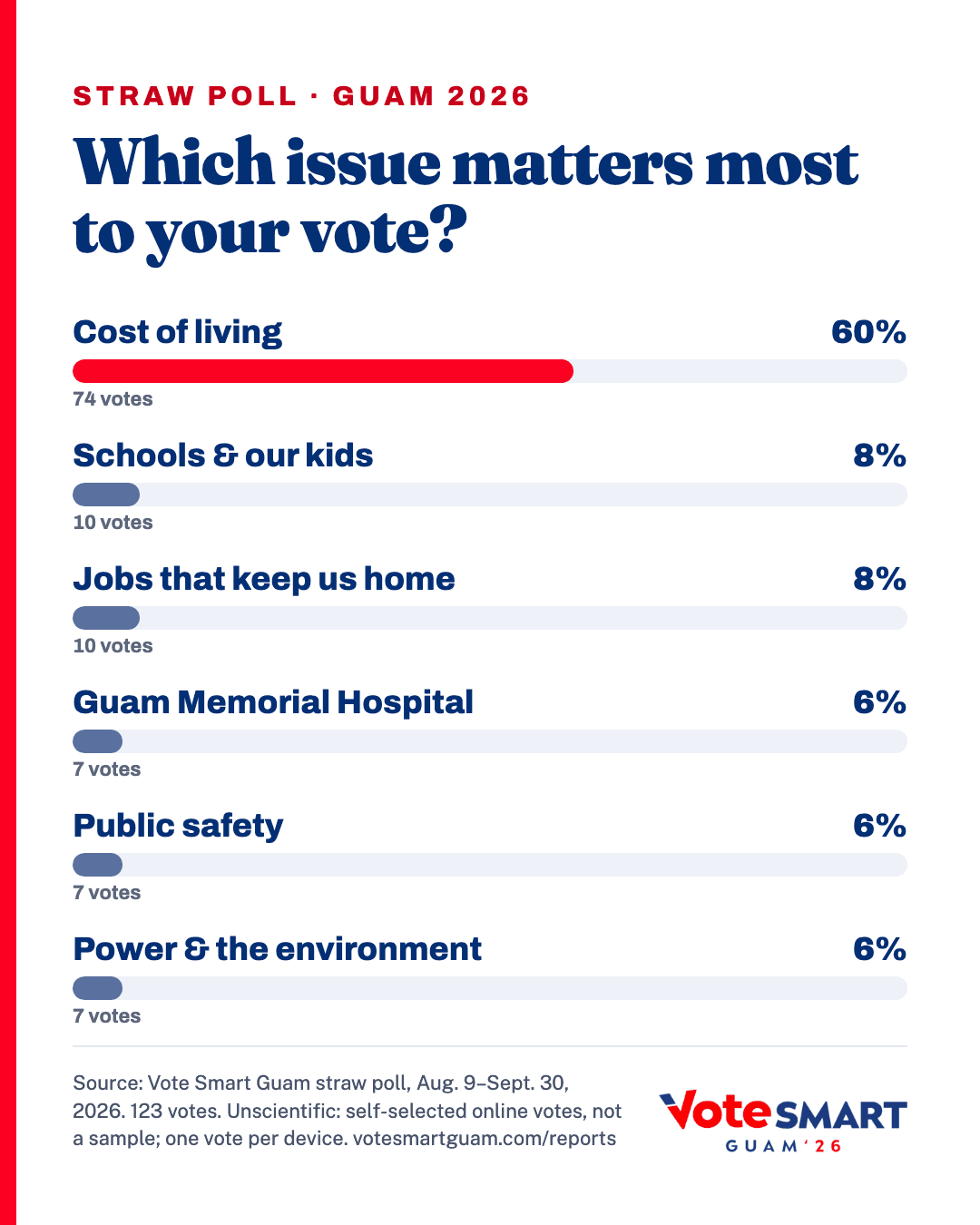
Among the issues included in the first round, cost of living received the most support, with 74 of 123 participants selecting it, representing 60% of the votes in that poll.
No other issue received more than 10 votes.
The results offer a snapshot of the priorities expressed by those who participated, rather than a scientific measure of the concerns of Guam’s overall population.
Voting restrictions and second round
Vote Smart Guam said each device could cast one vote per poll. The organization also limited voting from each internet connection to eight votes per poll until Sept. 15, when the limit was reduced to three to make repeated voting from a single connection more difficult.
All figures in the report are raw counts.
A second round of straw polls opened Oct. 1, with all counts reset to zero. The new round includes two ballots modeled on the actual election ballot: one allowing participants to select up to 15 of the 30 candidates for the Guam Legislature and another allowing them to select up to three candidates for the Consolidated Commission on Utilities.
The second round runs through Oct. 31.
Readers can review the full September results and access the current polls through Vote Smart Guam’s website at votesmartguam.com.
Editor's note: Vote Smart Guam provided this article for publication by Guam News Network. The organization describes its online straw polls as unscientific. Participation was voluntary, the results were not weighted, and the figures should not be interpreted as predictions of the Nov. 3 election.