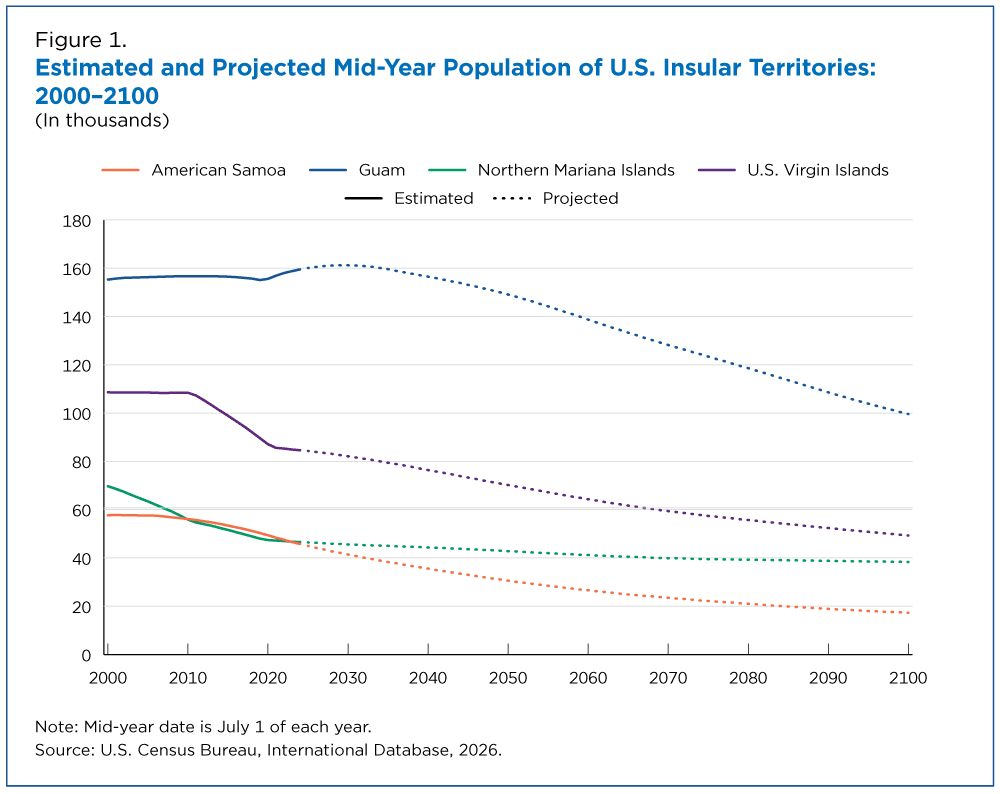
Guam's population is on a path toward decline according to the U.S. Census Bureau's Nov. 5 report which projects Guam's population will begin falling in 2030.
According to the U.S. Census Bureau's International Database (IDB), Guam's total midyear population in 2026 was 160,544, with a growth rate of 0.25%. However, the Census Bureau forecasts that Guam will "end the century with about 38% fewer people than it has now." Federal officials noted that Guam has already experienced a declining fertility trend over the past decade.
Based on Guam's 2026 population of 160,544 and the projection of a 38% decline, Guam's population could decrease to roughly 99,500 by 2100.
The report states that all U.S. territories are headed in the same direction, driven by a combination of falling fertility rates and persistent outmigration.
"Three of the territories have been experiencing population declines for several years — and all four are set to shrink by 2100," the report states.
Guam's fertility rate is declining but, according to the report, remains above the 2.1 total fertility rate (TFR) needed for long-term population replacement. TFR represents the average number of children born per woman.
"Guam experienced a 0.8 decrease in TFR over a 12-year period, from 3.2 in 2014 to 2.4 in 2026, and the U.S. Virgin Islands' TFR dropped from 2.5 in 2007 to 1.9 in 2026," the U.S. Census Bureau said, adding that Guam is expected to fall below the 2.1 TFR level in 2056.
Witnessing the decline
Dr. Thomas Shieh, a board-certified obstetrician and gynecologist who has practiced in Guam for 30 years, has witnessed the decline firsthand.
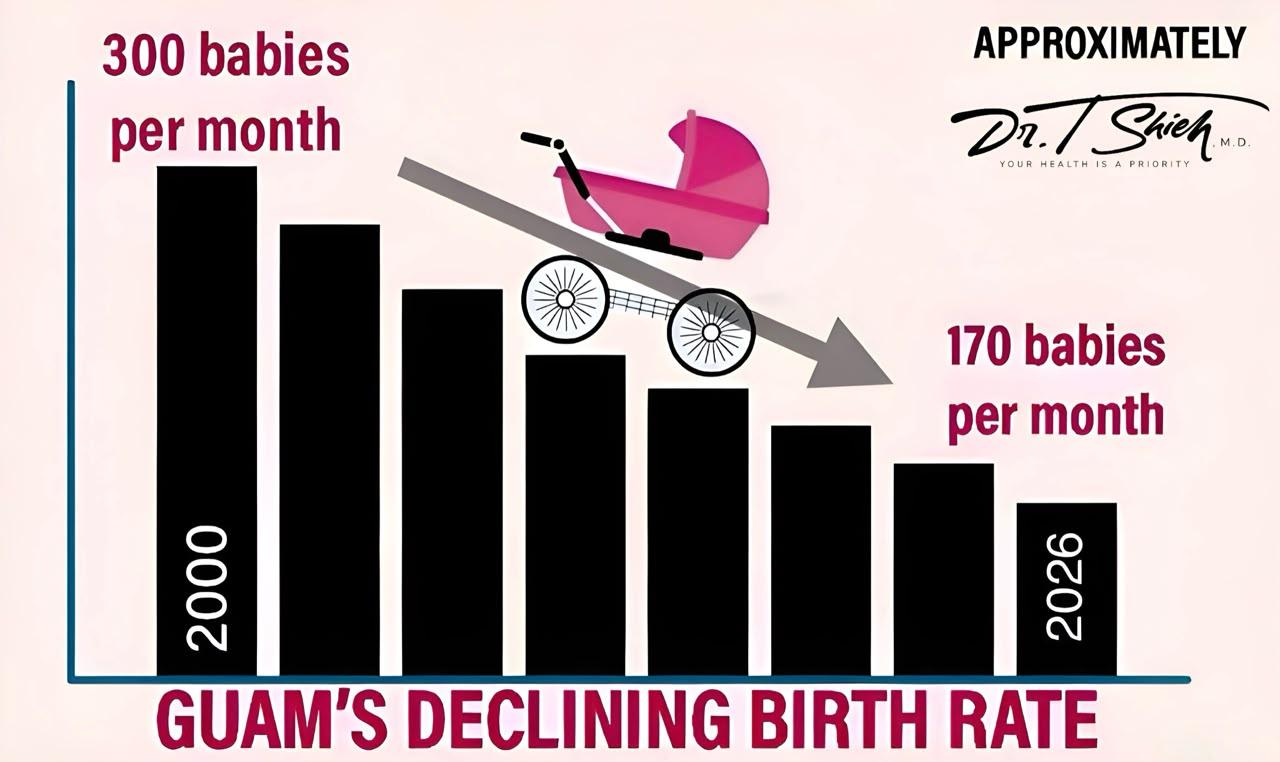
"I've been saying this for years," Shieh told Guam News Network, sharing a graphic showing that in 2000, there were approximately 300 births per month, compared with roughly 170 babies per month in 2025.
"The effects extend far beyond the delivery room. We are already seeing declining enrollment in our schools. Fewer babies today eventually mean fewer students entering our classrooms, and years from now, fewer locally raised young adults entering Guam’s workforce and contributing to our community and economy," Shieh said.
Guam Department of Education Superintendent Judith Won Pat in her State of Education address in October said public school student enrollment has declined across grade levels over the past five years.
She reported that elementary enrollment fell from 12,191 students in school year 2021-22 to 10,201 in 2025-26, a decrease of 1,990 students. Middle school enrollment declined from 6,262 to 5,110, a drop of 1,152 students.
High school enrollment fell from 9,044 students in school year 2020-21 to 7,810 in 2025-26, a decrease of 1,234 students, according to figures cited in the address.
Won Pat described the trend as troubling, she said, it has implications for school funding, staffing, resource allocation and the long-term sustainability of public schools.
Aging population
The IDB also points to an aging population in Guam, noting that the dependency ratio for people 65 and older is 22.2, compared with 38.1 for children ages 0 to 14. The median age is 34.6, with women at 35.7 approximately two years older than men at 33.7.
Another persistent strain identified in the report is net outmigration.
"More people have left than moved into each of the territories since 2000," the report states.
On Guam, that pattern briefly reversed during the COVID-19 pandemic.
"Guam saw fewer people leave than enter the territory during the COVID 19 pandemic — which hit in March 2020 — due to travel restrictions," the report states. "While net outmigration has started to pick up, it remains below pre-2020 levels."
The report states that projections for all four territories are based on the assumption that net outmigration will gradually decline and reach zero by 2100. According to the report, this helps maintain "realistic long-term population estimates for these small populations."
The report does not indicate whether the projections account for the military buildup in Guam.
U.S. Census Bureau proposed rule changes
The U.S. Census Bureau report follows a Sept. 10 announcement of new proposals that would prohibit questions about race, ethnicity and sexual orientation on the decennial census questionnaire.
The proposals would also establish new criteria for determining residency for congressional apportionment, including reliance on tax records and a Jan. 3 to April 1 reference period.
Right to Democracy, which alerted Guam News Network to the U.S. Census Bureau report, believes the proposed changes to the census could result in even lower population counts for Guam. The organization also drew a connection between declining populations in the territories and unilateral federal decision-making.
"These Census projections predicting a continued dramatic loss of population in U.S. territories are a striking indictment against the status quo relationship with the federal government. Unilateral federal decision making does not serve our interests. In order to thrive, our communities need power and agency over the decisions that impact our lives,” Adi Martínez-Román, co-director of Right to Democracy, said.
Right to Democracy argued that the proposed changes could also result in reduced federal funding because of gaps in census data.
"Data gaps impact federal funding determinations and limits understanding of the conditions and resource needs of the U.S. Territories," Right to Democracy said in its comment submitted to the U.S. Census Bureau on the proposed changes.
Right to Democracy emphasized that census data play an important role in determining how federal funding is distributed among states and territories.
"In 2021 alone, Census data, in whole or in part, were used to distribute $2.8 trillion in funding. More than 300 federal spending programs rely on census-derived data, as mandated by Congress. In the previous census, the Counting for Dollars Project at George Washington University confirmed that six federal programs are tied to the total population count," Right to Democracy said.
Right to Democracy stressed that census data are critical to programs directly tied to population counts, including the Supplemental Nutrition Assistance Program, Medicaid, Medicare, Section 8 housing assistance, Head Start, WIC and other public assistance programs.
"Artificially deflated counts could justify further cuts to capped federal grants for the territories," Right to Democracy said.