
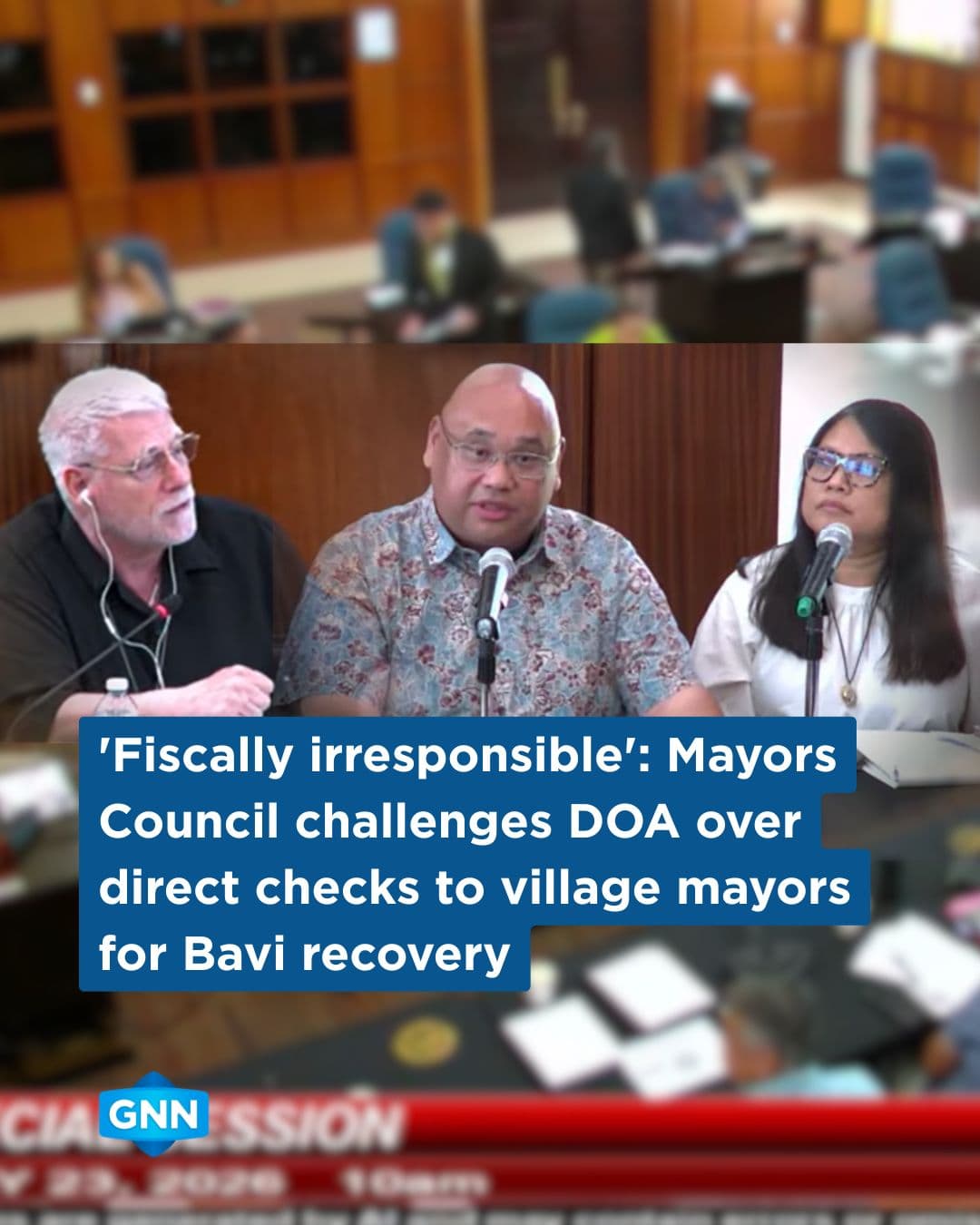
Tensions rose Thursday morning during a special session on Bill 1 (9-S), an act to appropriate roughly $13.4 million for Bavi response efforts, over Department of Administration checks cut directly to island mayors for initial response — a move the Mayors Council of Guam contends exposes them to fiscal risk.
Bureau of Budget and Management Research Director Lester Carlson confirmed during the hearing that the governor's funding request is separate from the budget bill passed by the legislature Monday. He also confirmed that roughly $8 million in unspent Typhoon Sinlaku funding was made available for initial Bavi response.
"Most of that money was taken up by the bill that appropriated, correctly so, rightly so, no argument about it, $250,000 to each mayor, $100,000 to the Mayors Council," Carlson said, noting the Guam Department of Education also received $250,000 for each school designated as a shelter.
Island mayors collectively received $4.8 million, Carlson said, acknowledging that mayors are a "huge first line of responders to the effort."
How that money was disbursed by DOA is the crux of the issue. Mayors Council of Guam (MCOG) President Mayor Jesse Alig told senators that last Friday their accountant received an email notifying them that no further encumbrances could be made because checks were being written directly to the mayors' offices.
"And the mayor's office is going to deposit it, perhaps, into their non-appropriated funds account, and figure it out from there," Alig said.
Alig took issue with "the lack of communication" from DOA on reconciling the funds before cutting checks to the 19 village mayors, two of whom have already returned theirs.
He said his advice to village mayors was "not to cash that check."
"Because we don't know what the actual balances are. Now, if they choose to cash the check, so be it, but then you have vendors out there that might not get paid. Invoices that are floating. ... Number two, who's certifying those funds?" Alig said.
MCOG Executive Director JoyJean Arceo, called to the table as part of Panel 1, confirmed she would not certify any of the funds or non-appropriated accounts noting she's already signed off on certifications for over 202 purchase orders based on the balance in their books.
"In the middle of Friday, when I'm told that the accounts are closed ... that puts me in a very bad position, because I started my funds, I've cut purchase orders, and I would really appreciate it if DOA would have called my office so that we can meet on this. Because, again, this is appropriation, it's taxpayers' dollars. We have to be accountable for this," Arceo said.
DOA Director Edward Birn defended the action, telling lawmakers he was following the language of the legislation.
"The legislation says disperse the money to the mayors. That's what the wording says for legislation. Disperse means pay. .. 17 out of the 19 mayors have taken that view ... and if they send the money back, that's fine," Birn said.
Finance Committee Chairman Sen. Chris Duenas pushed back, expressing concern with DOA's "independent determination" of the law, which he said bypasses "the proper procurement protocols."
"I think that was an arbitrary decision, especially with no communication, verbally or in writing. And I think they should not have to turn it back into you, Ed. I think you should recall those funds and distribute them through the proper process," Duenas said.
Duenas said the situation put mayors in "limbo."
"They're in limbo, to procure, to begin with, and now they're taking a chance by taking this check for $250,000 that you issued, put it in their non-appropriated funds — which is usually donations or other things that they get outside of the appropriation process from this legislature, an appropriation that the governor signed into law — and go out there and write a check, and say, deposit this in a non-appropriated fund, and go shopping. I think that's just wrong," Duenas said.
While Birn clarified that DOA did not specify which account mayors should use, Duenas asserted the non-appropriated funds account is the only other option aside from the Mayors Council's account.
"We thought we were doing the right thing by dispersing it. That, again — if I remind you, sir — that's what the law said. If the law had said something different, like it did with Sinlaku, then we would have proceeded in that way," Birn said.
Arceo called the disbursement method "fiscally irresponsible" and agreed with Duenas that the funds should be recalled and deposited into the Mayors Council's master account for proper procurement.
"I don't agree with any of these amounts to be deposited to a non-appropriated funds account that's not monitored. ... Because regardless of how you slice it, you put everyone at risk here, including the mayors," Arceo said.
Birn said he would cancel the checks but maintained DOA was following the law.
"So, if the mayors wish to reverse this arrangement, which we believe was following the law, right or wrongly — we thought we were following the law — then that's fine. The funds will be available to them this afternoon. They don't even have to return it," Birn said.
When asked whether the Mayors Council would still be able to complete recovery work with the funds, Alig said the check controversy had set them back five days but expressed optimism.
"Well, the way I understand the executive order, it's a 90-day term. ... I can tell you right now, we were behind five days already. So the goal is to supply the villages with their heavy equipment, or rentals, or whatever they need to recover and restore the villages back. Absolutely, the answer is yes," Alig said.