
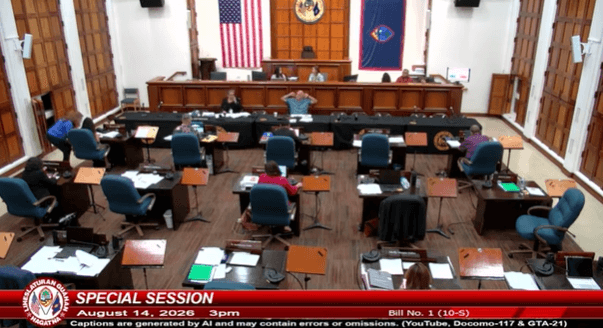
The 38th Guam Legislature will vote on Bill 1 (10-S), which covers fiscal year 2027 funding for the executive, legislative and judicial branches, on Monday following days of going through the proposal amendment by amendment.
Discussion on Bill 1 (10-S) on the special session floor brought several amendments. While several amendments passed, others, including giving the attorney general of Guam (AG) funding autonomy, failed.
The amendment proposed by Sen. Telo Taitague would have let the AG manage his own funding independent of the executive branch.
"So that they have the ability without their hands tied through the administration or ... the governor especially when it comes down to ... if this attorney general finds somebody in the administration that is causing more harm than good and has to prosecute them there could be repercussions ... it can become very political and what I am trying to do is take the politics out of it," Taitague said.
Speaker Frank Blas Jr. objected, contending it "infringes on the legislative authority for fiscal and for fiduciary responsibility" and would force the AG "to set up his own ... department of administration and BBMR (Bureau of Budget Management and Research)."
The amendment failed on reconsideration, though a related amendment giving the AG authority over its own procurement passed.
"It does not exempt the office of the attorney general from Guam procurement law whatsoever. The applicable um procurement requirements remain in place. What changes is who administers the process," Taitague said.
Taitague also pushed for an amendment that would restore the language that was used in substitute Bill 266-38, noting it was already incorporated in the fiscal 2026 budget bill as well as the vetoed fiscal year 2027 budget bill, but omitted from the governor's Bill 1 (10-S).
"So this particular amendment restores the $250 fine for each missed reporting deadline on the director of BBMR for the required appropriation, allocation and transfer reports, and importantly, that fine does not disappear into the general fund," she said.
Taitague said the fine would be deposited in the Department of Education's Interscholastic Sports Fund.
"The reason why these reports are coming in is because we put teeth to these laws that require them to provide this or they will be fined," Taitague said.
Other amendments that passed include requiring the Guam Department of Education to notify and hold input sessions with stakeholders before displacing classrooms for outside leases.
"All we're doing with this amendment... is requiring... that the deputy superintendent... shall provide reasonable public notice to affected stakeholders," Sen. Vincent Borja said.
Senators highlighted that language of the amendment appears prompted by the Science Is Fun and Awesome (SIFA) and George Washington High School relocation controversy.
Sen. Chris Barnett argued that the amendment "preserves the ability for GDOE to kick our special education students out of their classrooms."
Sen. Sabina Perez said the amendment "circumvents" existing law that required an appraisal and that GDOE receive proper compensation for leasing.
"It's already giving the superintendent the opportunity by discretion to lease properties without appraising, without doing, without complying with all these other safeguards that were passed by Public Law 38-66," Perez said.
Meanwhile, Sen. Therese Terlaje said Borja's amendment leaves things status quo without any "real parameters," nor does it resolve "what the problem really is."
"The problem is GDOE is claiming now they're on a frenzy to lease out their properties, to find spaces for charter schools to do all kinds of things instead of really focusing on making sure that we spend our federal funds properly, ... get teachers in the classrooms and make sure the special education students are not going to be the first that get moved around in schools," Terlaje argued.
Though Borja's amendment saw pushback, on roll call it was passed with nine ayes, four nays and two excused.
An amendment by Sen. Sabrina Salas Matanane, which would address the $21 million shortfall at the Guam Memorial Hospital, was also passed.
"It would go to the procurement of medical supplies, pharmaceuticals and consumables required for patient care. It would ensure that it wouldn't be jeopardized in FY27. It would go to payroll obligations, which is the hospital's largest fixed cost," Salas Matanane said.
Sen. Taitague was concerned about repeated bailouts without accountability.
"Guam Memorial Hospital will always be in the red. ... It's a hospital that requires to service anyone who walks in whether they can pay or not," Taitague said.
Sen. Perez added to the amendment requiring "an itemized report of proposed expenses ... provided to the legislature before disbursement of funds."
The amended Bill 1 (10-S) was moved to the third reading file and will be voted on Monday, Aug. 17, at 2:30 p.m.