
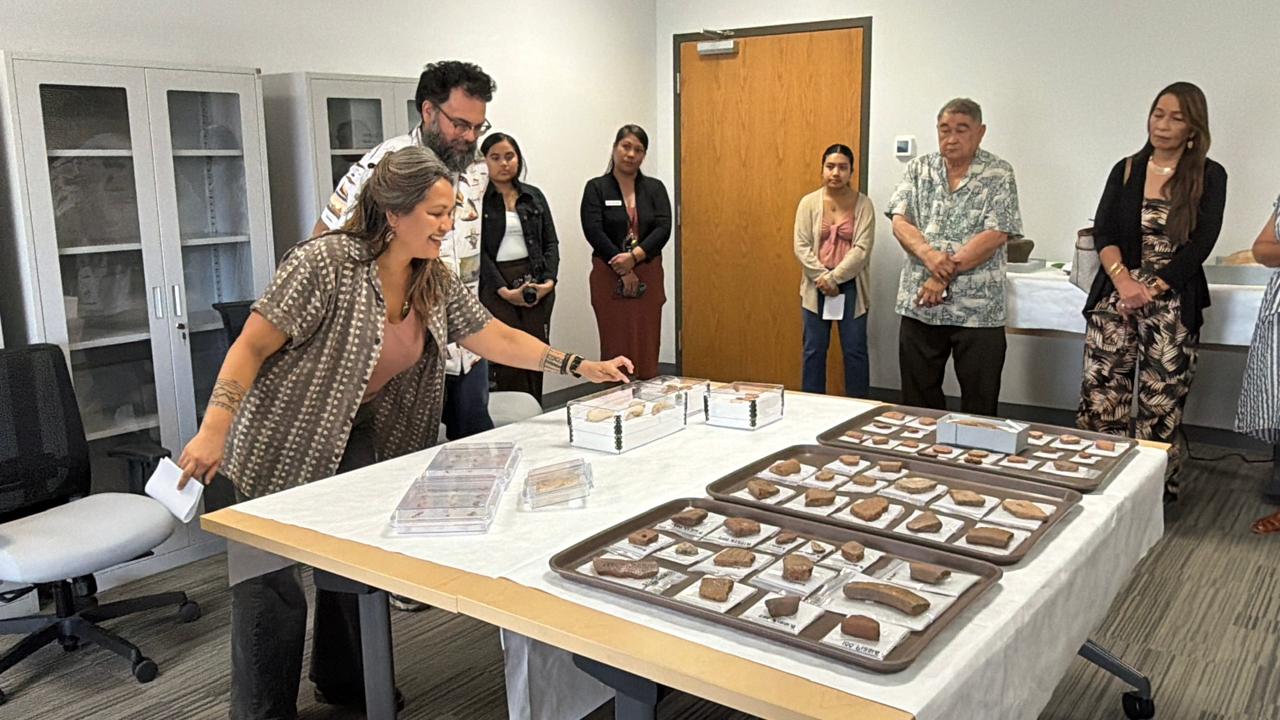
The second wave of cultural artifacts returned to Guam from the Bishop Museum in Hawaii carries stories of the CHamoru people that local officials are working to piece together through the study of items rematriated from the Hans G. Hornbostel collection.
Nicole Duenas, collections manager for the Guam Cultural Repository, said the artifacts displayed during Friday’s rematriation ceremony were part of the more recent return. Officials said the cultural items are being brought home in phases.
The second wave includes more than 3,000 slingstones used for hunting and warfare, decorated pottery, fishhooks from Dano, also known as Cocos Island, and other artifacts.
“This is one of the ones that really caught a lot of people's attention,” Duenas said, pointing to a pictograph taken from a cave in Talo'fo'fo.
During Hornbostel’s collecting activities from 1922 to 1926 for the Bishop Museum, he had the pictograph chiseled out of the cave, Duenas said. The removal left a visible absence, or scar, in the cave where the artifact had been taken, she said.
During the ceremony, Guam Museum Curator Michael Bevacqua discussed Hornbostel, describing him as an amateur archaeologist and Marine who collected about 10,000 artifacts over four years.
“The amount of slingstone, the amount of pottery he took was very shocking. Some curators at Bishop Museum were actually appalled that he took so much from a single place,” Bevacqua said.
The collection also includes a lusong, or stone mortar, that Hornbostel took from Yigo. Duenas said Hornbostel’s notes identify Yigo as the artifact’s origin, but its exact location is unknown and will require further research. The lusong was used to crush materials for traditional medicine, she said.
The collection also includes ancestral bone spear tips, which Duenas said were often carved from human bones.
“Ancestral bone spear tips was a practice that CHamorus — this is a practice that CHamorus did, where they used the bone, the leg bone, the largest bone in the body, to create these spear tips, and they are very often decorated,” she said.
Duenas identified one spear tip as having been collected by Hornbostel in Tumon, another from Ypao and additional bone pieces from Hagåtña.
The spear tip on display was carved from a human femur. Although now in pieces, the sections fit together, helping tell the story of ancient CHamoru craftsmanship and artistic traditions.
“They do connect together, so you'll see here that this is one piece, and you can see the decoration. What this sort of tells us, though, is, you know, CHamorus — our ancestors were a very innovative and artistic people,” Duenas said.
She said the artifacts offer insight into CHamoru storytelling, traditional medicine and warfare, including the use of pictographs in caves, decorated objects and slingstones for hunting and battle.
“We told stories through pictograph imagery in caves, you know, we — it tells us a little bit about, like, the traditional medicine traditions — this is what this piece can tell us — and then also, like, in addition to the slingstones, used for hunting, used for warfare, battle, and so that we do have, like, historical accounts that tell about, like, spear tips that had, like, sometimes poison in them,” she said.
The Guam Museum is targeting December for an exhibition of the returned artifacts. Officials are currently working to catalog the items and document their places of origin.