
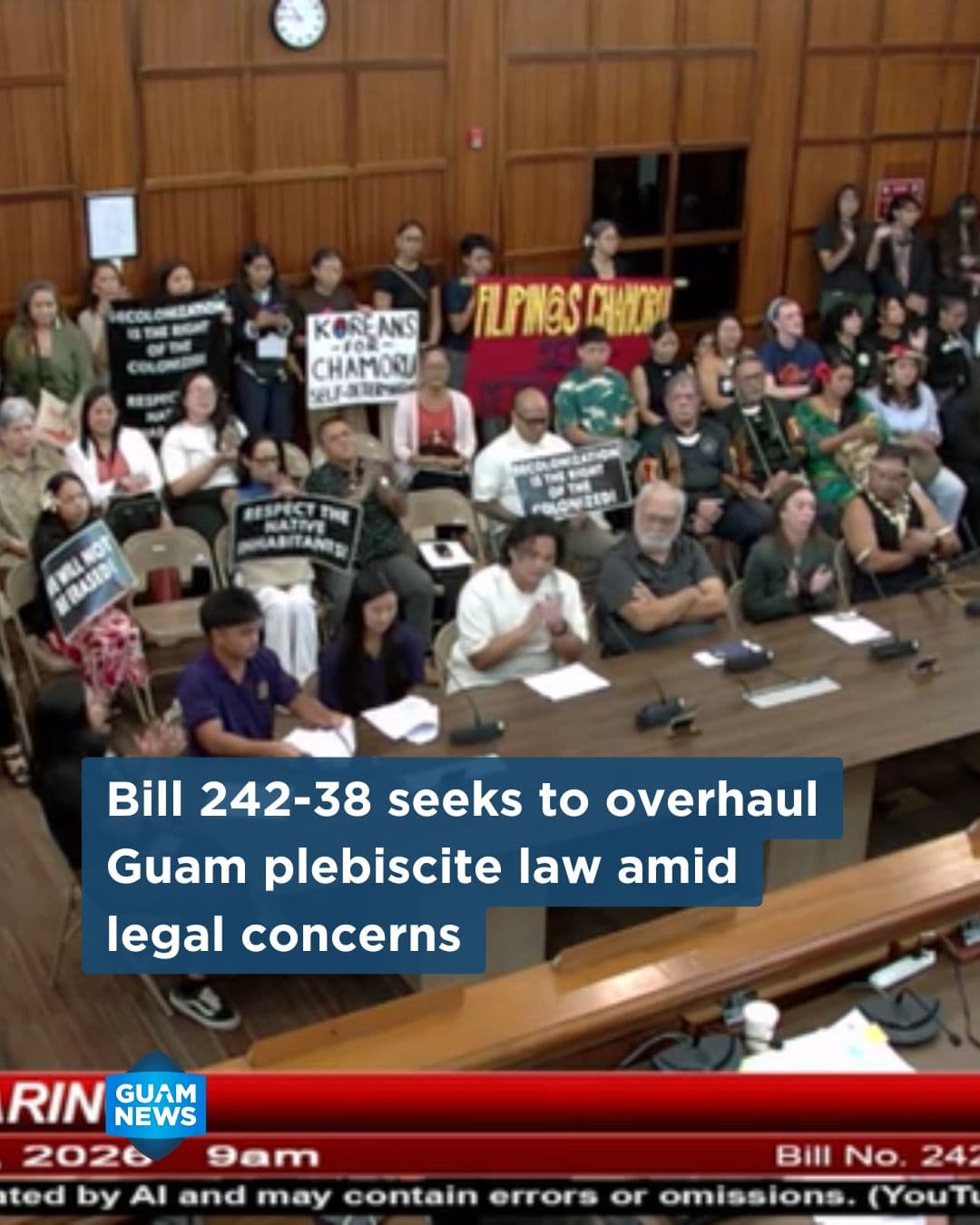
Lawmakers are weighing legislation that would fundamentally change who can vote in Guam’s long-discussed political status plebiscite, a proposal supporters say is necessary to bring local law into compliance with the U.S. Constitution but which critics warn could reshape the intent of the vote.
Bill No. 242-38, introduced by Sen. William A. Parkinson and under consideration in the Guam Legislature, would amend multiple sections of Guam Code Annotated to remove ancestry-based voter eligibility requirements tied to the island’s decolonization plebiscite. The measure proposes revisions to §§2102, 2104, 2105, 2110 and 2111 of Chapter 21, Title 1.
Why the bill was introduced
During a public hearing, Parkinson said the legislation responds directly to federal court rulings that struck down Guam’s previous attempt to limit plebiscite voting to certain descendants of the island’s “native inhabitants.” Courts determined those restrictions acted as a proxy for race and therefore violated constitutional protections.
He said the Ninth Circuit Court of Appeals found the prior law unconstitutional and that the Supreme Court of the United States declined further review, effectively ending Guam’s ability to hold a legally valid vote under the existing framework. Parkinson described the situation as a “legal wall” that has stalled progress toward a political status vote.
The senator argued that removing ancestry language would allow Guam to move forward with a plebiscite open to all registered voters, similar to the island’s 1982 vote, which used universal suffrage.
Legal testimony highlights risks
Testimony highlighted that the measure would address constitutional defects identified by federal courts. further noting that prior rulings made clear that limiting voting eligibility based on descent or ancestry would not withstand judicial scrutiny and would likely trigger successful legal challenges if left unchanged.
Another attorney, Michael Phillips, cautioned lawmakers that any future plebiscite must be structured carefully to avoid repeating past legal pitfalls. He emphasized that courts have consistently treated ancestry-based classifications as suspect when tied to voting rights.
Testimony submitted by the Office of the Attorney General of Guam, led by Attorney General Douglas Moylan, was also entered into the legislative record for consideration.
Supporters: Bill clears path forward
Backers of the proposal say it is a practical step toward reviving a stalled self-determination process. They argue Guam cannot hold a binding political status vote until its laws are consistent with federal constitutional standards.
Parkinson said the goal is not to redefine self-determination but to create a lawful mechanism for measuring public sentiment. He told lawmakers the current statute effectively prevents any plebiscite from occurring because it conflicts with controlling court precedent.
Critics: Change could alter purpose
Opponents, however, have raised concerns that removing ancestry provisions could dilute the original intent of the plebiscite, which was designed to gauge the political wishes of Guam’s indigenous community. Some testimony suggested lawmakers should explore alternative frameworks rather than fully eliminating the criteria.
What happens next
The hearing concluded with the bill remaining under legislative review. Lawmakers indicated additional testimony may be accepted if not all participants were able to speak within time limits.
If enacted, Bill 242-38 would mark one of the most significant revisions to Guam’s political status statutes in decades, potentially resetting the path toward a long-anticipated vote on the island’s future relationship with the United States.