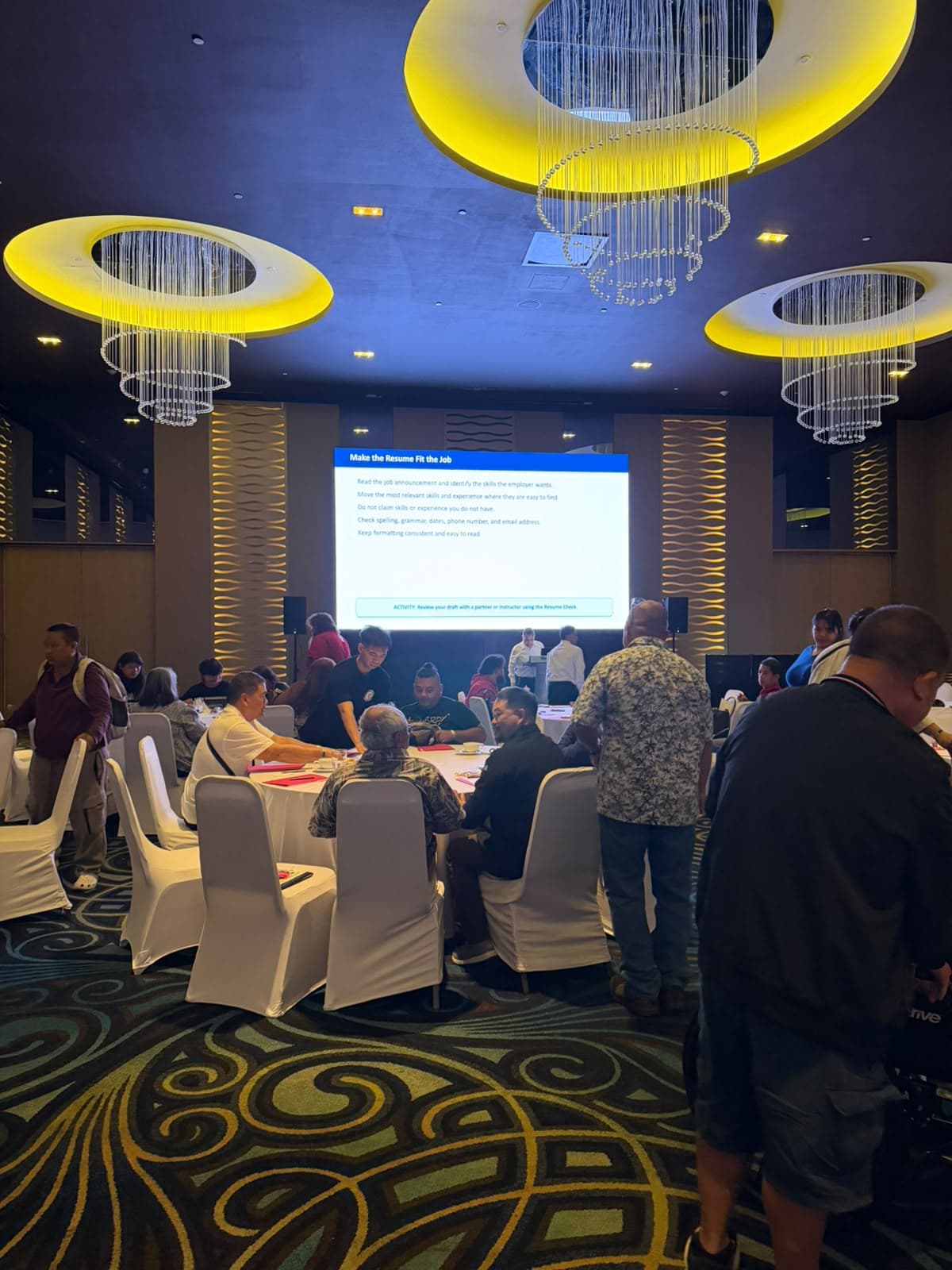
On Tuesday, 48 businesses participated in the Division of Vocational Rehabilitation's Business Engagement Unit's first Business Engagement Program, connecting employers with individuals with disabilities to explore career, training, work experience and employment opportunities.
Organizers said 237 individuals attended the event including 65 DVR clients, all who shared the same goal of wanting to build connections between employers and individuals, explore opportunities and learn how to lean in on their strengths, skills, interests and abilities to advance career goals. Charlie Hermosa, a local business partner presented at the event providing attendees with the employer's perspective.
"One of the things that I am doing is presenting a workshop that will give them from an employer's standpoint some skill sets that they can take with them so that they can actually go out and get a job," Hermosa told Guam News Network.
Hermosa said his goal was to provide training in basic skills needed to secure a job.
"So, those things are resume writing, ... dress to impress, to ensure that they know how to be able to dress through a specific interview or how they would dress to go to work. And the third one is interviewing tactics, being able to teach them just quick and easy things that they can do whenever they're going to go towards an interview, to get a job," Hermosa said.
Rather than focusing on a person's disability, DVR works to identify each individual's strengths, abilities, interests, skills, employment goals and informed choice. Attendees were paired with employment and training opportunities that align with what they are capable of doing successfully and the career pathways they have chosen.
"One of the things we don't discuss is disabilities, what we do discuss is abilities. We look at their skill sets, what they do well at, and we want to be able to match those skills sets with a potential employer or job that they can do," Hermosa said.
The job landscape has changed since COVID-19 which open the door to remote work environments.
"The evolution of being able to work from home is another great example of things that weren't offered to us in the past, but now that's an accepted practice within a lot of the workforce. So, it's really about opening doors to ensure that the potential employees or the customers understand that there's no such thing as a disability. We want to be able to focus on their abilities," he said.
Hermosa said attendees in his workshop were asked to write down their objectives, and job interests.
Heromosa's presentation also touched on soft skills employers want potential employees to have with a "dress to impress" exercise.
"So, we're going to talk about grooming, we're going to talk about the aspects of clothing items that could potentially change the dynamics of your appearance. I could be wearing a t-shirt, if I put on a simple coat, change the dynamics of the way you look, a backpack versus a computer bag, change the dynamics of what you do. So those are ... really the soft skills that we want to be able to concentrate. Just going back to the basics, I think a little bit, on the grooming side is going to be really important and this is something that we've learned from, employers. Employers are really looking for the soft skills to come back," Hermosa said.
Attendees also had the opportunity to meet with the 48 participating businesses that were looking for new talent. Hermosa said beyond the event, DISID and DVR programs offer training and even funding to help attendees reach their job goals and get into the mindset of “yes.”
"Absolutely. The one example that we use today from is the fact that if you don't have a license, yes, we can train you and send you to school for you to get a license. If you don't have the equipment, yes, you can come to us, and we'll provide you the equipment. And yes, if you need the outreach and support, we have it here for you. So, I think that is exactly, uh, we want to be able, for everybody that's here today, to walk away, saying that, yes, they can," Hermosa said.