
Cost of living stands out as the top concern among Guam residents who took part in two community measures run by Vote Smart Guam, the nonpartisan voter guide, ahead of the Nov. 3 General Election.
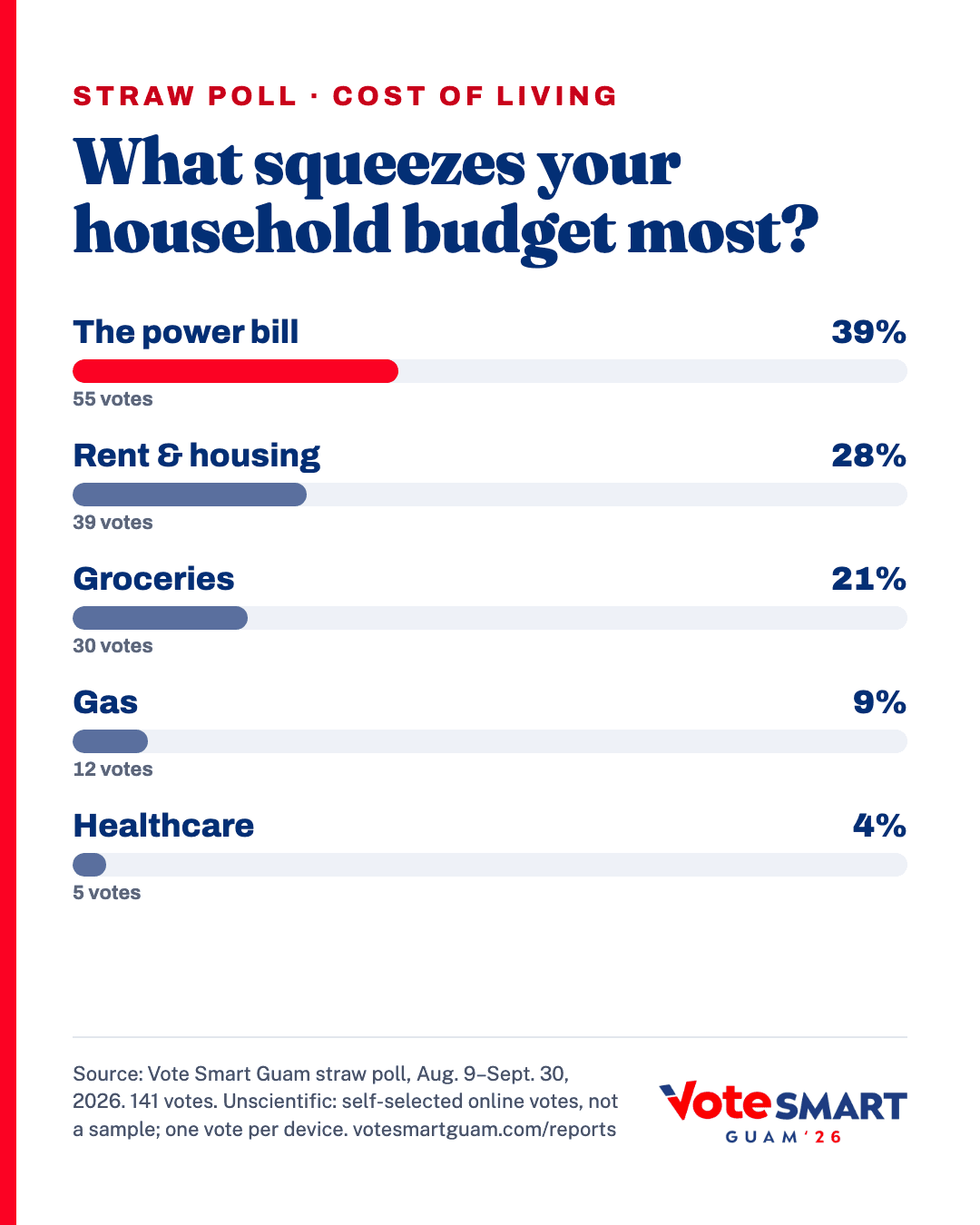
In the organization's online straw poll, 74 of 123 voters or 60% named cost of living as the issue that matters most to their vote. Asked what squeezes their household budget most, 55 or 39% of 141 said the power bill, followed by rent and housing at 39 or 28%, groceries at 30 or 21%, gas at 12 or 9% and healthcare at 5 or 4%.
Vote Smart Guam's separate, anonymous Community Voices survey found the same pattern. Of 209 respondents, 128 or 61% chose cost of living as the issue that matters most to them. Jobs and the economy came second at 19%.
The concern held across age groups and regions: 70% of respondents aged 18 to 24 chose it, 53% of those 25 to 34, 64% of those 35 to 49 and 62% of those 50 to 64. By region, 66% in the north, 57% in central Guam and 65% in the south picked it.
Cost of living was also the most common theme when people described the island's biggest issue in their own words, raised in 39 of 94 written answers or 41%. "The price we pay just to live on Guam, where majority of us are born, raised, and wish to be, is way higher than what companies are offering to pay employees," one respondent wrote.
Votes Smart Guam said, "The Community Voices survey is anonymous and self-selected, not a scientific sample. It ran on votesmartguam.com from June 29 to Sept. 30, 2026, and drew 212 responses. Percentages are of people who answered each question. Written answers were sorted into themes by Vote Smart Guam; one answer can count toward more than one theme."
Vote Smart Guam's October straw polls follow up with questions on what would help households most and what the power utility should prioritize. They are open through Oct. 31 at votesmartguam.com/polls.
Editor's note: This article was prepared by Vote Smart Guam for Guam News Network. The nonpartisan organization's straw polls are unscientific, no one was sampled, and results were not weighted. They do not predict the election. Each device could vote once per poll, and each internet connection was capped (8 votes per poll until Sept. 15, then 3). All figures are raw counts.