
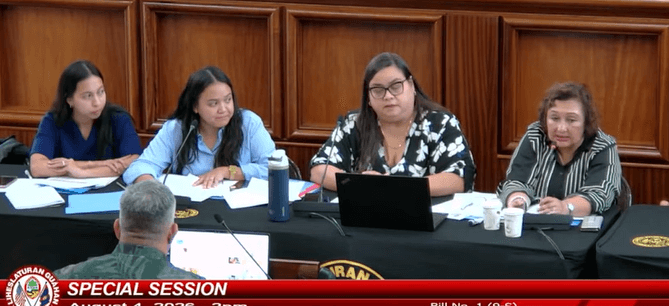
A number of factors weigh heavy on providers and families under the Child Care Development Fund Program, from federal funding uncertainties, and disparities, to the benchmark used to set Guam's subsidy rate. The concerns were raised during special session discussions on Bill 1 (9-S) between the Department of Public Health and Social Services (DPHSS) and senators examining the bill offered by the Governor.
Sen. Will Parkinson pointed to changes on the federal front and President Donald Trump's desire to "put the responsibility of childcare and Medicare and Medicaid onto the states, for them to handle."
Parkinson called on fellow senators to consider providing annual funding at a "base level."
"And if we could get more federal dollars to supplement it, great. If we can't, at least we have a base level of services that we can provide. ... People really care about this issue, and I think that there should be a base level of investment from our own government. Divorced from federal dollars, so that no matter what happens with the capriciousness of the federal government, we have a base standard of guaranteed that we can potentially lean on to fill the gaps.," Parkinson said.
DPHSS anticipates receiving $22M for Fiscal Year 2027 from the federal government, but CCDF program costs have already exceeded that for the current fiscal year, prompting the department to request $7.6 million from the legislature to pay childcare provider subsidies owed for June and to carry the program through the end of the fiscal year on Sept. 30.
Senator Sabrina Salas Matanane the legislative committee chair on Health and Veterans Affairs, sought clarification on how the $700 subsidy rate was determined noting that she met with childcare providers for two hours last Friday. Their concerns formed the basis for her questioning.
DPHSS said the $700 maximum subsidy rate took effect Jan. 1, based on an alternative methodology survey conducted in calendar year 2024 and research and planning committee through January 2026, guided by federal counterparts.
The survey reflects responses from 35 out of 70 childcare providers with a committee comprised of seven childcare centers making the final determination based off the study.
DPHSS confirmed a lack of parity exists between the local subsidy rate and the CCDF subsidy provided to military families on Guam, telling Sen. Matanane that military CCDF funding is based on a separate methodology.
"They get $2,000 per child, while we are figuring out $700 max because of the total amount, we get paid. I know it's very different, but ... that's how they get it. They get it from a totally different ... probably Department of Defense, or now Department of War, same way they get housing allowance. It's so high compared to ... outside," Arriola said.
Arriola said the department could ask Congress to bring parity "between inside and outside the gate," but first needs "to figure out where their money is coming from and then ask our congressman to try to advocate to get some parity from inside to outside the fence."
When asked whether the issue had been raised with federal counterparts, DPHSS noted that talks over bringing parity during a meeting with regional sessions were met with recommendations to seek alternative supplemental grants or ask the local government to step in.
DPHSS also confirmed that while Guam's CCDF subsidy rates are comparable to Hawaii's it was not on the list of states federal counterparts asked them to review.
"Mississippi was the one that made most sense for Guam. ... We were also comparing along with Puerto Rico, Mississippi, and Arkansas ... out of the three Mississippi was the most comparable to living within our $22M means," Irish Davis program coordinator for the Bureau of Child Care said further explaining if they chose Hawaii, it would be over the $22M Guam was provided.