
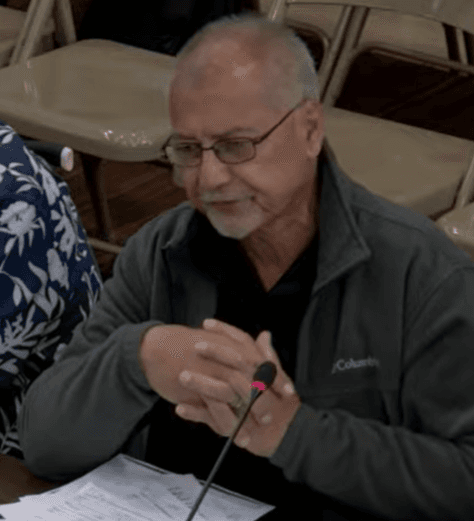
Guam will receive a record $105.07 million in Section 30 funds after federal officials approved the island's $85 million request for fiscal 2027 and added nearly $20 million in positive reconciliations from prior years, according to Bureau of Budget Management and Research Director Lester Carlson.
"Initially when we put the governor's executive budget request together and submitted it to the legislature January 31 of this year, we took a long, hard look at Section 30," Bureau of Budget Management and Research Director Lester Carlson told Guam News Network on Thursday.
He contended that Guam's growing military and federal contractor presence, and Camp Blaz expansion warranted the larger Section 30 estimate.
"So, we actually thought that, even the increase in military population, that we could certainly justify requesting for $85 million, so that's what we did," Carlson said.
Carlson said that the federal government basically agreed to give Guam its ask and then some. He said that the higher projections totaling $105 million in Section 30 funds for the current fiscal year are a result of revised estimates. But he stressed that amount is subject to reconciliation.
"The money is an advance, but then after the dust settles, the federal government has to do a reconciliation to see whether or not the advance given to us was on point, too much or too little," Carlson said.
Reconciliation is the federal government's process of comparing estimated Section 30 payments against actual tax collections and adjusting future payments accordingly.
He explained that the fiscal team and administration requested the federal government reconcile the military reimbursements which had not been completed in the last four or five fiscal years.
"Because we believe that we're owed more money from prior years. So, we made that ask in person in February and then when the governor sent her letter and it again reiterates the point that we would love to have an additional look at Section 30 and we cited a Tetra Tech report that actually indicates more DoD personnel, more of their building, civilian workers anticipated because we now have the missile defense system on top of Camp Blaz," he said.
Carlson stressed that the hard work paid off. He reported that the response letter from the U.S. Department of the Interior informed the administration Wednesday morning that $85,187,739 is the estimated advance payment for fiscal 2027 Section 30.
"They basically agreed to give us what we asked for. On top of that, they gave us another $19,885,394 for reconciliations for 2018 military cover-over for non-filers, 2018 home of record filers ... And then additionally they did a 2022 federal agency cover-over, 2023 federal agency cover-over and a 2024 agency cover-over." Carlson said.
He said that all but one year were "positive adjustments."
"So, it ended up being short just of $20 million, in addition to that $85 million. That's how we got the $105,073,133. It was a lot of work. It was long, hard effort to get our federal partner to take a look," Carlson said.
The payment is called an advance because it still requires reconciliation.
"It's up to Treasury and IRS to reconcile and then come back later on and say, oh, your estimate was too low. We owe you some more money. Uh, or it was too high, and you, you know, we're going take it out of your, your next year's allotment. So, if we ask for, say, 85, but we are overpaid in a prior year, then, they'll take away from the 85 what it was that we were overpaid," he said. "It really was difficult and, you know, very time-consuming effort, but, you know, the results speak for themselves."
He confirmed that fiscal years 2025 and 2026 still require reconciliation.
"There's no mention of 2025, ... so that probably is something that needs to be done. So, the possibility of future reconciliation, hopefully in our favor is still there. But it's up to us to push and to ask," he said.
The $105 million in Section 30 funds will go into the General Fund. He said aside from debt obligation tied to a Section 30 bond; the money is not earmarked for specific projects.
"For this year, $17,768,125. So, the first $17.8 million comes off the top, and the rest of it goes into the General Fund," Carlson said.