
Editor's note: This is part three in a series exploring birthright citizenship and birth tourism on Guam and the Northern Mariana Islands.
H.R. 9724, the End Birthright Citizenship for Territories Act, has drawn pushback from Gov. Lou Leon Guerrero, Delegate James Moylan and Right to Democracy - but it has also found support from a local obstetrician-gynecologist.
According to the bill's author, Rep. Morgan Griffith (R-VA-9), the proposed federal measure applies only to territory-born children of non-U.S. citizens and would not affect territory-born children of U.S. citizens born on or after Jan. 1, 2027.
Griffith said the intent is to stop the so-called "birth tourism" taking place in the American territories - an occurrence he characterized as "abuse of birthright citizenship."
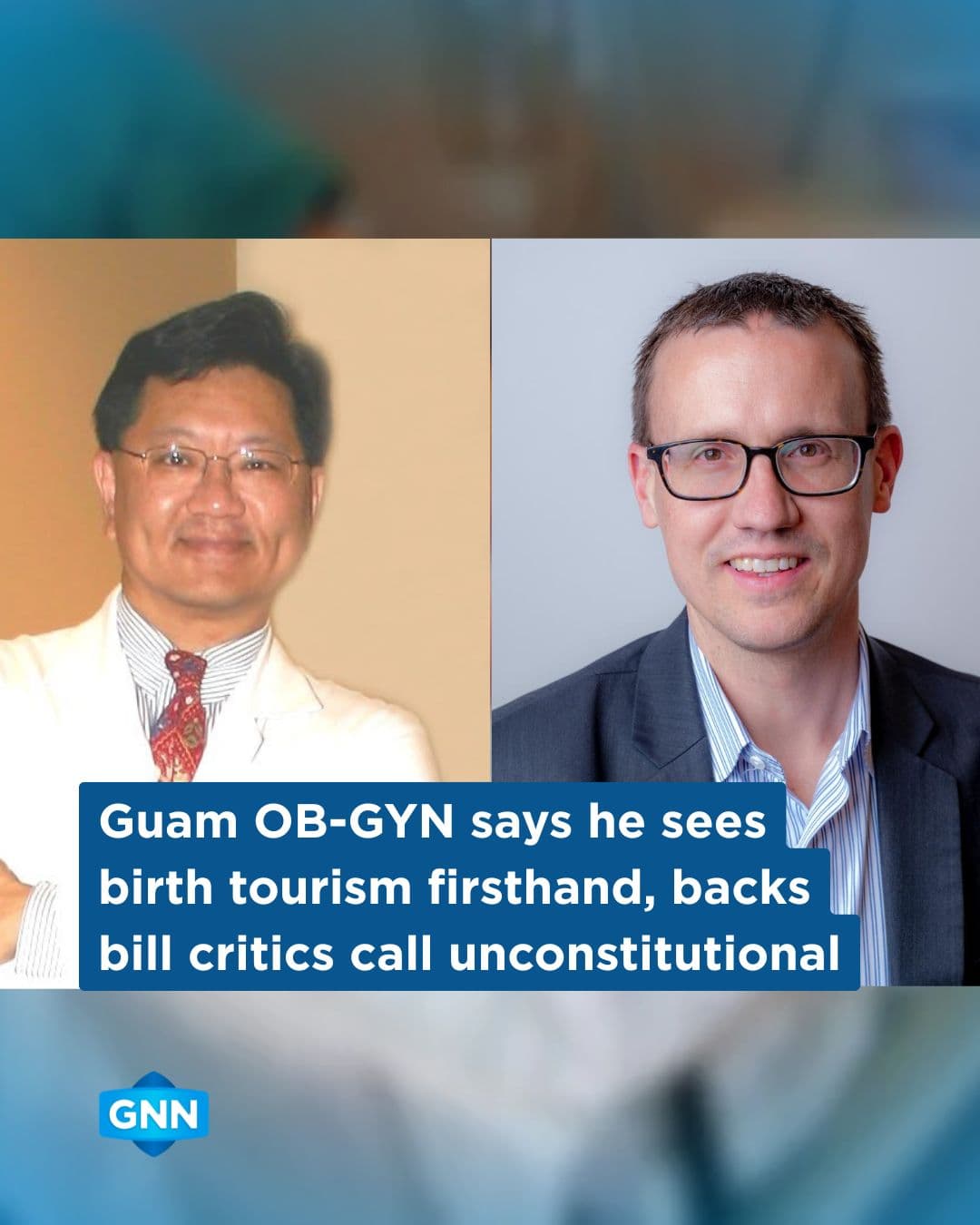
That is the aspect of the bill that local OB-GYN Dr. Thomas Shieh, who has practiced on Guam for 30 years, supports.
"What I have read does not take away our right to obtain our citizenship. I am an immigrant, my parents entered the U.S. legally and we went through seven to eight years for our naturalization. To cheat the system, by lying to immigration, that's just wrong," Shieh told Guam News Network.
Shieh's reading of the bill differs from that of Right to Democracy, a project co-founded by Adi Martinez Roman and Neil Weare, which contends that the bill's language leaves territory-born children of U.S. citizens after Jan. 1, 2027, with uncertain 14th Amendment protections.
"They mis-cite relevant portions of the U.S. code (don't accurately cite Guam portions at all) and don't include the limiting language in the actual amendments. It's a giant mess, pretty embarrassing honestly," Weare told Guam News Network.
A review of the bill's language - specifically Sections 3 through 6 - shows proposed amendments to the automatic citizenship statutes for Puerto Rico, the U.S. Virgin Islands, Guam and the Commonwealth of the Northern Mariana Islands, each with a hard Jan. 1, 2027, deadline added to the existing automatic citizenship clause.
None of the four amendments specifically state an exception for children of U.S. citizens or aliens lawfully admitted for permanent residence born in the territories.
For Guam, Section 5 of H.R. 9724 cites INA §307 but gives the U.S. Code citation as 8 U.S.C. §1406 - the provision for the U.S. Virgin Islands.
Right to Democracy noted: "Because these limitations are not included in the actual statutory amendments, it leaves open the question of how they might be interpreted by the courts. When Congress has legislated these kinds of distinctions in the past, it has done so expressly. For example, under current law, 'a person born in [American Samoa] of parents one of whom is a citizen of the United States' is recognized as a U.S. citizen, while children born to non-U.S. citizen parents are not. 8 U.S.C. § 1401(e)."
Right to Democracy characterized the bill as "poorly drafted," leaving its impact on Guam "not entirely clear."
"But if it were to pass, it could put at risk the citizenship status for anyone born in Puerto Rico, Guam, the U.S. Virgin Islands, or the Northern Mariana Islands as U.S. citizens on or after January 1, 2027," the organization said.
While local leaders are working to block H.R. 9724 in the House, Shieh encouraged Right to Democracy to focus on protecting Guam "against foreign invasion" and to help amend the bill's language rather than oppose it outright.
"Let's not make it sound like it is targeting Guam and territories against our rights as U.S. citizens, or those who come in legally and seek it. My parents immigrated to the U.S. legally and did it the right way. Some may disagree with Vice President James David 'JD' Vance and President Donald Trump on how they are addressing this issue, but the reality is they are. Those who criticize have not offered good solutions," Shieh said.
Shieh said he is on the front lines of the issue, having witnessed birth tourism firsthand on Guam. He estimated at least 70 to 100 babies are born on Guam through birth tourism each year, though he stressed that producing solid numbers is difficult.
"Hard to know because they are 'undeclared,'" he said. "I know at one point, the business of birth tourism in Guam must have been several hundred a year. I know, because I would get calls for appointments, but I would discourage them from coming in for that purpose, at one point, almost daily I would get calls."
Neither Guam Memorial Hospital Authority nor the Department of Public Health and Social Services collect citizenship data from expectant mothers who give birth on Guam. Both said the only identifier collected is race.
Shieh contended there is a "right way and a wrong way" to obtain U.S. citizenship, saying "birth tourism is the wrong way," and called on Weare to help amend the language to prevent it.
He said birth tourism compounds a system already strained by a perennial shortage of OB-GYNs on Guam.
"The issue at hand, with the lack of access to prenatal care on Guam, birth tourism can prosper, but at the expense of our local moms. If I wanted to just do birth tourism, none of my patients would have access to prenatal care. Do we blame those doctors who engage actively in birth tourism? No, it's a business venture, and it's good revenue, so I don't blame them," Shieh said.
Shieh said he does receive calls from hotels to assist in situations where a non-U.S. citizen delivers a baby on Guam without intent, and said he will help in those cases. He stressed, however, "I do not actively engage in birth tourism."
When asked, Weare said the bill "should be pulled entirely, as both unconstitutional and improper, not edited."