Department of Public Works Director Vincent Arriola called for federal partners to invest in Guam's transportation infrastructure based on data he said shows how the military buildup is increasing demands on roads and bridges that support everyday traffic and the national defense mission.
Arriola presented the data during the Office of Local Defense Community Cooperation meetings in San Francisco, California. His presentation included a $570 million cost to strengthen the infrastructure of Routes 1, 15, 17 and 9.
"This is the transportation package in front of us: Routes 1, 15, 17, and 9. These are not disconnected road projects. Together, they connect the port, the airport, medical facilities, communities, and the major defense installations," Arriola said in a post on Gov. Lou Leon Guerrero's Facebook account.
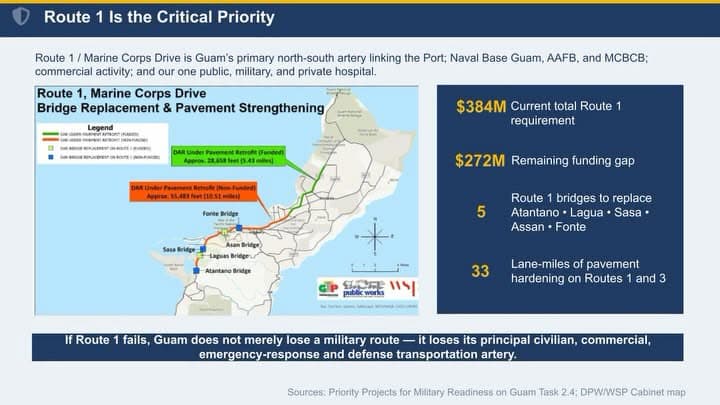
The presentation slides break down the four-corridor package costs by project. Route 1, at $384 million, is identified as the "critical priority." It includes replacement of five bridges - Atantano, Lagua, Sasa, Assan and Fonte - and 33 lane miles of pavement hardening on Route 1 and Route 3. DPW asked the Department of War to fund the $272 million gap in costs.
"Marine Corps Drive, or Route 1, is one example. The corridor connects Naval Base Guam to Route 3 and U.S. Marine Corps Camp Blaz and is critical to the movement of military personnel and assets. At the same time, it remains Guam’s main artery for civilian traffic, including employees and contractors supporting the buildup," the governor's post states.
Replacing the five bridges, according to local officials, will "ensure Guam’s transportation infrastructure can continue supporting both our community and the national defense mission."
Route 15, at $141 million, includes a five-lane expansion from Route 10 to Route 26. Arriola told federal partners this will improve access to Naval Base Guam in Barrigada and the future Guam Memorial Hospital.
Route 17, which will cost $85 million, includes repaving, widening and replacing Aplacho Bridge. Arriola said the project will provide "cross-island" redundancy to NMS.
Route 9, at $72 million, focuses on a 3.3-mile stretch from Andersen Air Force Base to Marine Corps Base Camp Blaz and Potts Junction. Arriola said this supports personnel and logistics movement.
The timeline for the four-corridor package is fiscal 2026 through fiscal 2029.
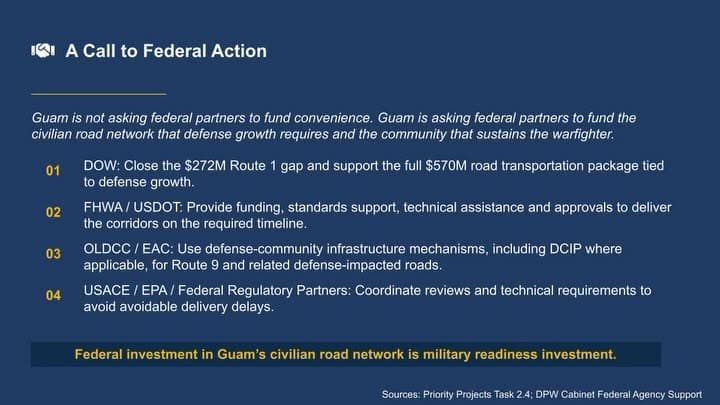
Arriola called on federal officials to take action, stating, "Guam is not asking federal partners to fund convenience. Guam is asking federal partners to fund the civilian road network that defense growth requires and the community that sustains the warfighter."
Arriola asked the Department of War to close the $272 million Route 1 funding gap and support the full $570 million in transportation projects tied to military growth. He also asked the Federal Highway Administration and U.S. Department of Transportation to provide funding, standards support, technical assistance and approvals to deliver the corridors on the required timeline.
He asked the OLDCC and Economic Adjustment Committee to use defense-community infrastructure mechanisms, including the Defense Community Infrastructure Program, or DCIP, where applicable for Route 9 and other defense-impacted roads.
Arriola also asked the U.S. Army Corps of Engineers, Environmental Protection Agency and other federal regulatory partners to coordinate reviews and technical requirements to avoid perceived delivery delays.