
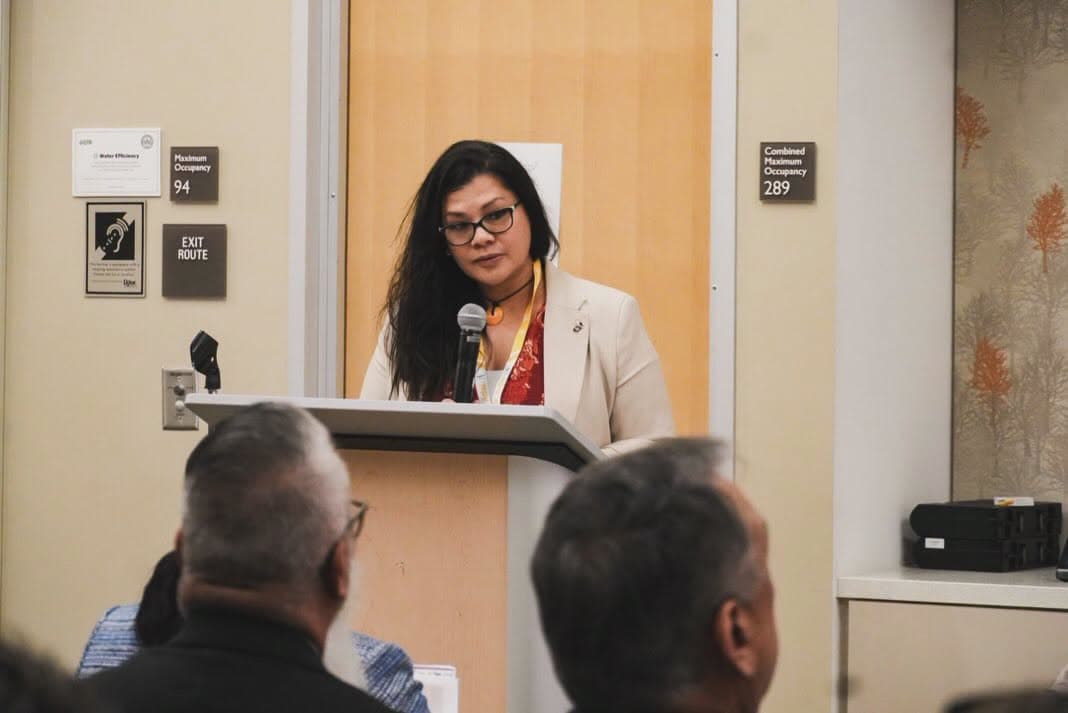
Guam Memorial Hospital Authority Interim Hospital Administrator and CEO Dr. Joleen Aguon presented Guam's case for federal investment in the island's health care infrastructure as part of national defense and in response to the impacts of the military buildup.
Aguon told federal officials that the island's only public hospital has 161 beds and that 40% of active-duty visits to GMHA are emergency visits. Meanwhile, Naval Hospital has 42 beds, with "space-available" patients at Guam military facilities accounting for 27% of visits in 2024.
According to Aguon, the demand for increased bed capacity at Naval Hospital is expected to reach "47 this year, 62 by 2034." The impacts attributed to the military buildup include more than 5,500 Department of War civilians and contractors in Guam who will only receive military care "if space allows."
Gov. Lou Leon Guerrero's Facebook account highlights that there are roughly 25,000 active-duty service members, reservists, National Guard members, Department of Defense civilians and dependents in Guam. She said that population is expected to grow to between 35,000 and 44,000 over the next decade.
"That growing population relies on Guam’s civilian health care system, including an average of 4,000 interactions each year with Guam Memorial Hospital. At the OLDCC convening in San Francisco, GMH Interim CEO Dr. Joleen Aguon outlined Phase 1 of the proposed new hospital campus in Mangilao, and the infrastructure needed to support Guam’s growing defense mission," Leon Guerrero said in the social media post.
During the Guam breakout session with federal partners, Aguon noted that the military buildup's impact is one of three "pillars."
Aguon said, "Component 2 is a new 186-bed hospital, 500,000 square feet, 5 stories, a 600-space parking garage, a helipad, a full-site work on 44.86-acre campus, totaling $1.3 billion. A total phase one estimated construction cost with a 30% contingency is $1.6 billion."
Aguon pointed out in her presentation that 1.9 hospital beds per 1,000 people in Guam is far below the U.S. average.
She contended that although GMHA has kept the current facility "open as the safety net" and has partnerships with Naval Hospital and The Guam Regional Medical City, a private hospital that handles overflow, the public hospital risks failing accreditation if it remains unfunded. She said overflow protocols would result in "a 7-hour flight," with no dedicated evacuation aircraft.
Aguon stressed that federal capital is needed to support 80 to 100 beds, a TRICARE overflow agreement and military health record exchange. This involves two projects: GMH Expansion and Modernization and Northern Guam Community Health Center Expansion.
The preliminary cost of the GMH Expansion and Modernization project is estimated at more than $250 million from fiscal 2026 through fiscal 2030. This includes $150 million for facility improvements and the electronic health record system and $100 million for surge beds for Camp Blaz and an "ends evacuation overflow."
Preliminary costs for the Northern Guam Community Health Center Expansion are $25 million. According to Aguon, this "expands the front door for Camp Blaz families and relieves GMH emergency room pressure."
Aguon said, "Component 3 is a veterans clinic, co-located on the same campus with adequate space to properly serve our veterans on island. Currently, our veterans are served by two small outpatient clinics. Co-locating a right-size VA clinic on the new GMH campus lets veterans use one campus for VA care, and when they need it, the acute care services are right next door. One hospital, one VA clinic, one coordinate project."
The total preliminary federal request to fund, endorse, agree and connect is more than $275 million for both projects. Aguon said this builds on the Department of War's $2.7 million 2024 grant to GMH.
Leon Guerrero said, "A One Guam approach to national defense must also account for the health care infrastructure that service members, their families, and our entire island depend on."
Aguon is part of a delegation of senior Government of Guam officials who accompanied the governor to the Office of Local Defense Community Cooperation meetings in San Francisco, California which Adelup called "high-stakes talks" focused on managing Guam's "massive military expansion and solidifying its indispensable role in Pacific defense."