
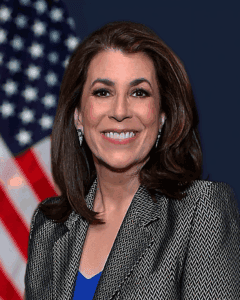
The United States called for the dismantling of the U.N. Special Committee on Decolonization during the General Assembly's Fourth Committee session on Oct. 15, with U.S. representative Tammy Bruce arguing that the body has outlived its original purpose.
Bruce explained the U.S. position on voting against all resolutions and decisions under the agenda. She said the votes “do not change U.S. policy on the underlying questions.”
Bruce said the Special Committee on Decolonization's ongoing work “wastes the UN's time and resources.”
“In spite of this, the Special Committee operates as though nothing has changed. Revisiting the same texts every year wastes the UN's time and resources, as do the Special Committee's yearly junkets to resorts in the Caribbean and South Pacific,” Bruce said.
She also argued that the Special Committee “refuses to accept outcomes other than independence.”
“As the 1970 Declaration of Principles of International Law concerning friendly relations reflects: the people of a non-self-governing territory may validly choose free association, integration with the administering state, or any other political status, provided they freely determine it. The Special Committee should not presume to speak for these peoples or intervene in the internal affairs of a sovereign state and its relations with non-self-governing territories,” Bruce said.
Bruce also specifically referenced Guam in her remarks.
“We incorporate, by reference, our points from prior years, including the U.S. sovereign right to conduct military activities in accordance with its national security interests and consistent with international law, and disagreement with the criticism of a U.S. federal court ruling which enjoined Guam's planned plebiscite on self-determination. These and earlier resolutions, including Resolution 1514, are non-binding and do not necessarily reflect international law,” Bruce said.
The U.S. position has drawn concern from Right to Democracy, a project that works to advance democracy, equity and self-determination in U.S. territories. The organization said the call to end the committee's mandate comes “even as self-determination for its own 'unincorporated' territories remains unrealized.”
In a statement released Thursday, Right to Democracy said Bruce objected to criticism of a U.S. federal court ruling that blocked Guam's planned plebiscite on self-determination.
“It is true that the people in Non-Self-Governing Territories deserve better - the people Puerto Rico, Guam, the U.S. Virgin Islands, American Samoa, and the Northern Mariana Islands should enjoy full political rights and self-determination long denied to them by the United States,” co-director Adi Martinez Román said.
Right to Democracy said unincorporated territories, including Guam, are subject to Congress' “plenary power” and U.S. sovereignty while being denied basic democratic rights and self-determination.
Although people born on Guam are U.S. citizens, they generally cannot vote for president while residing on the island. They can vote in presidential elections if they establish residency in a state or the District of Columbia, subject to applicable election laws. Guam's delegate to the U.S. House of Representatives also cannot vote on final passage of legislation.
“The colonial relationship between the United States and its Territories is a direct contradiction of U.S. democratic values, constitutional principles, and international human rights commitments,” Román said.
Right to Democracy said the Special Committee on Decolonization oversees implementation of the Declaration on the Granting of Independence to Colonial Countries and Peoples.
Under Chapter XI of the U.N. Charter, administering powers have an obligation to promote the well-being of people in non-self-governing territories and to develop self-government, according to the organization.
“Seventeen NSGTs remain under the consideration of the Special Committee. Three of them are U.S. Territories: Guam, the Virgin Islands of the U.S., and American Samoa,” Right to Democracy said.
Guam's political status remains unresolved. The options recognized in the U.N. decolonization framework include independence, free association and integration, with the choice to be made freely by the people concerned.
“While more must be demanded of the United Nations, it is ultimately the United States that has failed in its commitment to advance self-determination for the people in U.S. territories under its rule. As the United States celebrates the 250th anniversary of rejecting colonial rule in the Declaration of Independence, it must ensure that principles of ‘consent of the governed’ apply equally to people in U.S. territories today,” said Neil Weare, co-director of Right to Democracy.