
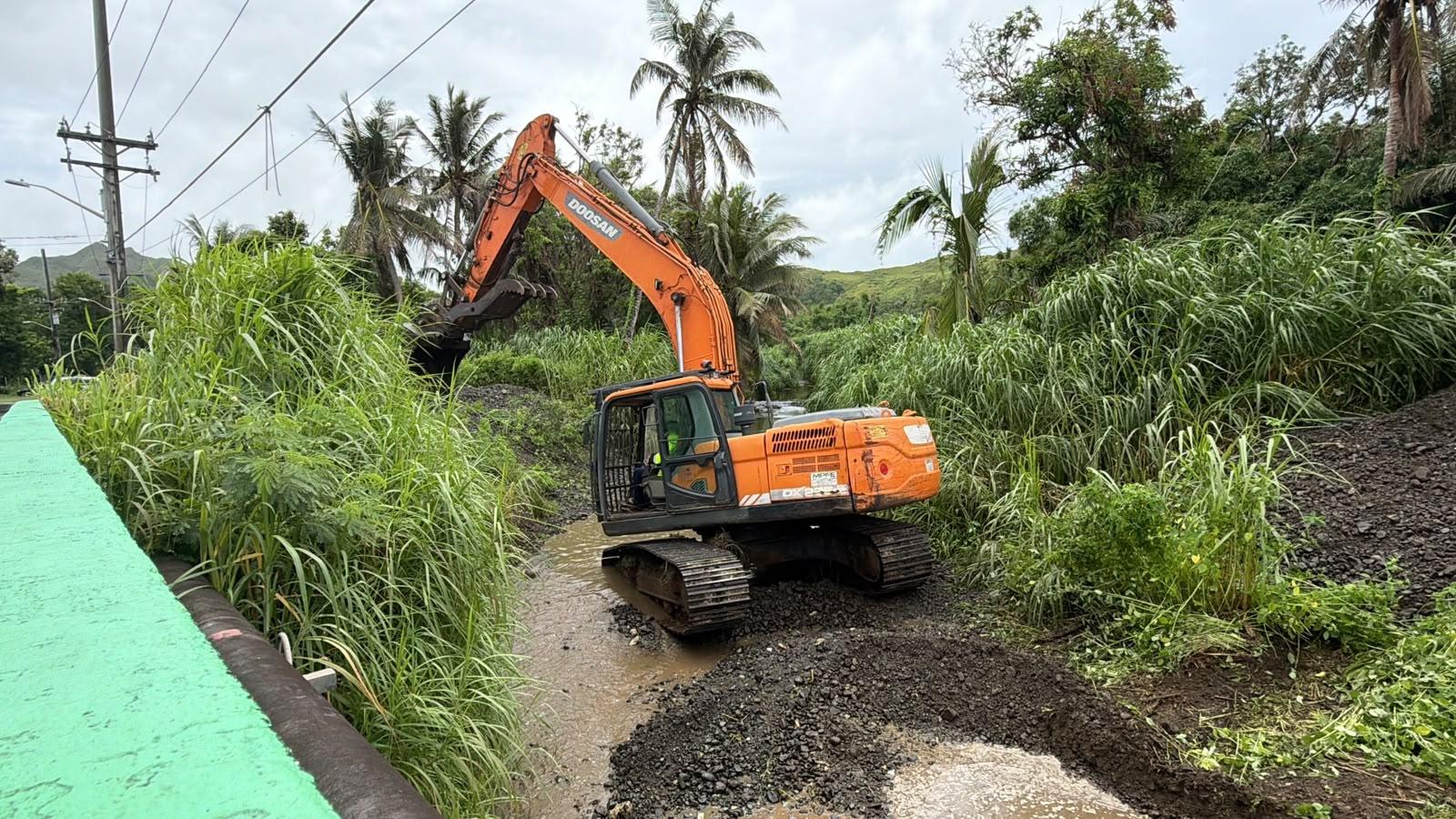
$21.28 million went into Typhoon Bavi response, as of Nov. 6 about $14.56 million remained, according to officials who during the oversight hearing held by legislative Chair of the Committee on Public Safety, Emergency Management and Guam National Guard Sen. Shawn Gumataotao answered questions about Typhoon Bavi response, expenditures and encumbrances, Federal Emergency Management damage assessments and after-action reports.
According to Bureau of Budget and Management Research Director Lester Carlson reported that the $21.28 million was made available through an emergency executive order and two public law. The funding included $250,000 authorized by the governor, $7.67 million appropriated through Public Law 38-134 and approximately $13.36 million provided through Public Law 38-135.
Carlson reported that of the $7.67 million, roughly $4.6 million has been spent, $875,000 encumbered leaving a remaining balance of approximately $2.14 million. Of the $13.36 million, $12.39 million remains. He also reported that $33,000 remains from the emergency funds ordered the governor.
Public Auditor BJ Cruz expressed concern however that his office had yet to receive receipts.
"I noted that you read the law that said there were supposed to be receipts to our office within five days. We've not received one receipt to date," Cruz told lawmakers. By law the Office of Public Accountability is to conduct an audit of Typhoon Bavi expenditures within six months of the enactment.
Typhoon Bavi brought gusts up to 100 miles per hour, and rain up to 24 inches. Through the storm five emergency shelters were operated with a 1,703 capacity and at peak of the storm 868 people sheltered, according to Acting Homeland Security Advisor Lucia Perez.
The storm resulted in power outages across the island. Restoring the islandwide power grid to 99% took eight days.
Perez said the government's preliminary damage assessment submitted to FEMA totaled approximately $19.17 million. FEMA validated $6.14 million, with much of the difference attributed to costs considered unsupported at that stage, insured, ineligible or lacking documentation.
"On Oct. 7, the president approved our major disaster declaration with individual and public assistance islandwide. 33 government of Guam agencies have applied for public assistance," she said.
As of Nov. 11, FEMA had received 5,781 registrations and distributed more than $7.2 million to Guam households, Perez said. Residents have until Dec. 7 to register for assistance.
Perez also reported 196 homes damaged across 18 villages, including 68 with major damage and 10 that were destroyed. 488 businesses were surveyed, 209 of which reported storm-related losses totaling approximately $3.9 million in physical damage and $4.9 million in estimated revenue loss.
The Bureau of Statistic and Plans Deputy Director Mathew Santos estimated that Bavi generated approximately 18,000 cubic yards of construction debris, metal waste and green waste, equivalent to more than 900 dump truckloads.
Guam Recovery Office Deputy Director Jack Hattig reported that 31 projects totaling roughly $1.22 million associated with Typhoon Sinlaku and 389 projects with total costs at $81.657 million tracked for Typhoon Mawar. But for Bavi, Hattig said, there are no obligations as of Thursday's oversight hearing.
"We're still going through recovery scoping meetings and we're still identifying damage. We have 60 days from the date of the disaster. So, we have nothing to report there," Hattig said.
Sen. Sabrina Salas Matanane questioned the status of the Paseo seawall project. Santos confirmed the issues are being addressed by the Army Corps of Engineers.
"They already came out with four types of designs. The lowest cost option is going to be around $18 million. They're going to cover up to $10 million which is their cap. So we're left with around $7.6 million. So we have to cover that with a local source," Santos said.
The Mayor's Council of Guam reported spending approximately $4.1 million of the $4.8 million allocated to the council. The funds supported contractual services, overtime and heavy equipment purchases.
The Department of Agriculture reported approximately $815,944 in payments through its Crop Loss Compensation Program, with another payment of approximately $21,000 pending for two commercial farmers. The department also estimated approximately $50,000 in overtime expenses related to its response.
DOAG's Director Chelsa Muna explained that compensation is based on farmers' expenses and inputs used to grow crops, rather than the value of crops lost. Crop losses are addressed through other programs, including federal assistance and crop insurance.