
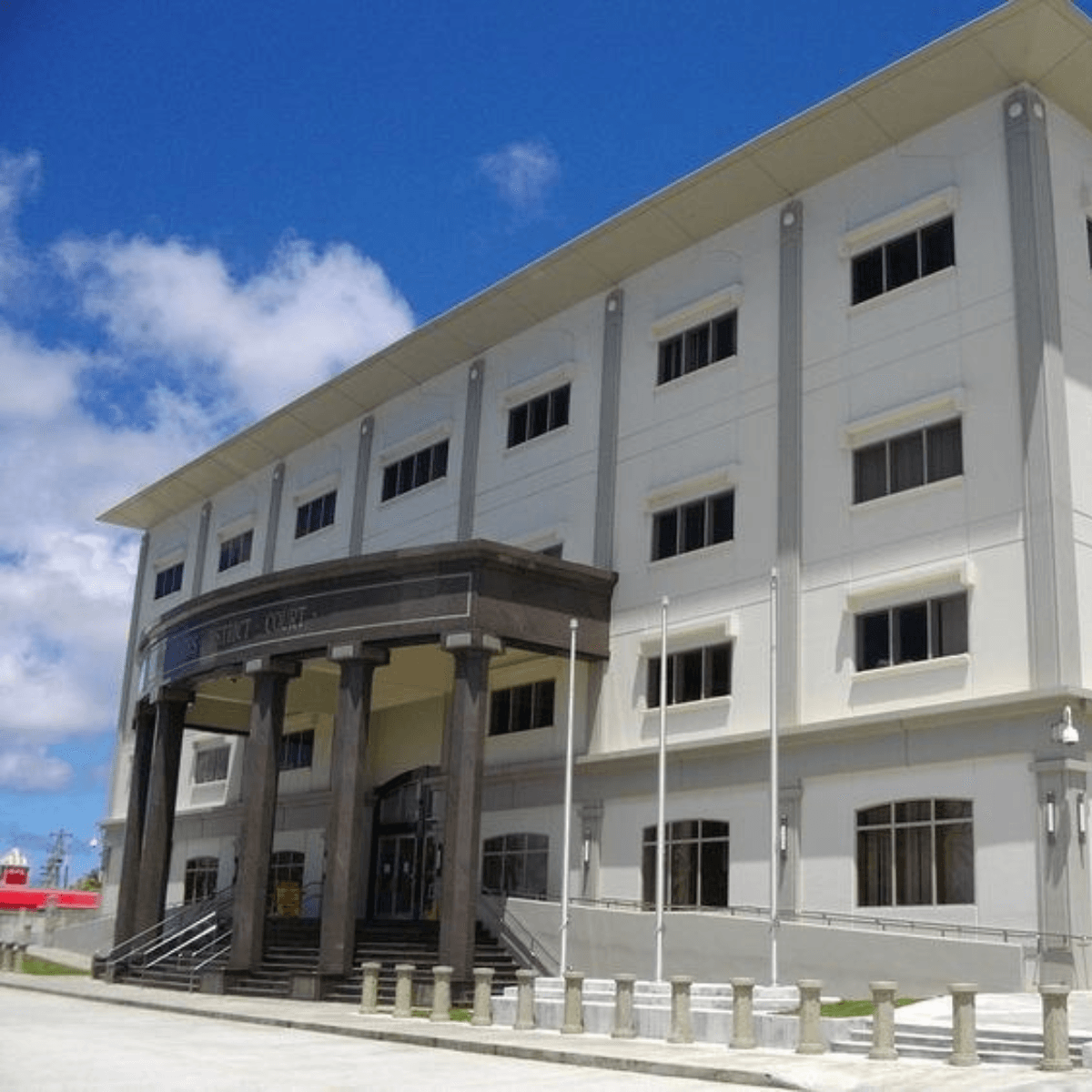
The District Court of Guam has issued two decisions in a methamphetamine distribution case involving Richard Roy Sablan and Marty Pinaula Michalec, ruling that some evidence must be suppressed while allowing the prosecution to proceed against both men.
The men are being adjudicated separately in a case involving allegations of conspiracy to distribute 50 grams or more of methamphetamine, possession with intent to distribute 50 grams or more of methamphetamine, and possession with intent to distribute five or more grams of methamphetamine.
In Sablan’s case, U.S. District Court Chief Judge Frances Tydingco-Gatewood considered a motion seeking to suppress evidence seized from two postal packages, his arrest, his cellphone and statements he made to officers. Sablan also sought dismissal of the case with prejudice.
“Specifically, Sablan requests that the court suppress the evidence seized from the two separate postal packages, the evidence seized from his arrest, the evidence seized from his phone, and the statements he made to the officers,” Tydingco-Gatewood stated in her decision and order.
According to the court documents, the Drug Enforcement Administration determined that the first package contained 7,992.6 grams of methamphetamine hydrochloride with a purity level of 99%.
Investigators replaced the drugs with sham materials, a tracking device and a breaching device designed to signal when the package was opened. The package was then sent to its intended destination at the Garden Villa Hotel.
The breaching device was later activated in the parking lot of a store in Yigo. Officers found Sablan and Michalec inside a silver Jeep. Investigators reportedly observed a substance on their hands suspected to be methamphetamine and recovered $2,165 in cash.
The court acknowledged that the tracking device placed in the first package was authorized under a deficient warrant. It also found that the government had placed the breaching device inside the package without express authorization in the warrant.
However, Tydingco-Gatewood ruled that the officers acted in good faith and that the breaching device did not require separate authorization because it was not a tracking device.
A second package contained 9,760 grams of methamphetamine hydrochloride with a purity level of 99%.
The court found that the government seized the second package from the lobby of the Garden Villa Hotel without a warrant and transported it to the Barrigada Post Office, where a drug-detection canine alerted to the package.
Although the second package was addressed to the same Garden Villa Hotel location as the first, it did not include “Apt. #200,” according to the court documents.
Sablan also challenged the warrantless search of his cellphone.
“Sablan contends the evidence from the packages, his resulting arrest, his phone and his statements should all be suppressed and that the case against him should therefore be dismissed,” the court stated.
The judge found that Sablan had standing to challenge the package searches even though he was neither the sender nor the addressee.
However, she upheld the cellphone search, noting that Sablan did not dispute signing a consent form. His objection concerned the late production of the form, according to the decision. The judge also rejected his Fifth Amendment claim.
Tydingco-Gatewood granted Sablan’s motion to suppress the methamphetamine seized from the second package but denied his request to dismiss the case.
In Michalec’s separate proceedings, he joined the motion to suppress evidence and dismiss the case against him.
The court examined testimony from an evidentiary hearing concerning the impoundment and search of Michalec’s Toyota Corolla, which was also in the parking lot of the Yigo store. Tydingco-Gatewood described the impoundment as a “ruse for general rummaging in order to discover incriminating evidence.”
The judge also called the government’s reliance on the community caretaker doctrine “disingenuous,” citing two reasons: The government failed to present evidence that the vehicle was impounded for public safety, and officers did not follow their usual impoundment procedures.
“Officer Grey explained that the officers only kept the Corolla overnight because they believed that Michalec would need a vehicle to drive home after he was released from jail. He further testified that, had Michalec’s sister come to retrieve the Corolla on the evening that the car was taken, the officers would have released it then,” the court stated.
The judge found that the officers had not formally impounded the Corolla because they released it rather than turning it over to the U.S. Marshals Service.
“Both the automobile exception and the inventory search doctrine does not apply to this warrantless search, therefore any evidence obtained from the Corolla is suppressed,” the court stated.
The suppressed evidence includes methamphetamine found in the vehicle. However, Michalec’s oral statements unrelated to the Corolla remain admissible, according to the ruling.